


Spinvox: The end of the saga
- 30 Dec 09, 18:22 GMT
The call with news of a deal in the technology sector came mid-afternoon on 30 December, a day when much more important news was breaking, so I realise that the sale of Spinvox to Nuance may not attract a lot of attention. But it brings to an end the remarkable and rather sad story of what seemed to be one of Britain's most promising young technology businesses.
At the beginning of 2009, Spinvox was apparently riding high, winning awards for its ground-breaking voice recognition technology, recruiting some of the brightest and best in the telecoms and marketing industries, and signing big contracts with the world's leading telecoms operators. But behind the scenes, it was wrestling with huge issues surrounding both its technology and its finances - issues that we revealed on this site in July (see here, here and here).
Now a company that had raised well over $200m from blue-riband backers like Goldman Sachs and Carphone Warehouse has been sold for $102.5m (around £64m) and about a third of that in Nuance shares rather than cash. The Nuance press release unveiling the deal makes no mention of the company's founders Christina Domecq and Daniel Doulton, and in fact features no quote from anyone at Spinvox - highly unusual in this kind of announcement. So the deal raises a number of questions, which I've put to both Nuance and to Spinvox
(1) Will the backers get their money back?
Neither company was at all forthcoming on this issue; but bearing in mind that a £30m loan - due before Christmas - needs to be repaid, it appears there's little left for the investors. Those who were in at the start - like Carphone Warehouse - may have written off their stakes already. As for Christina Domecq, who at one stage had the biggest stake: hers were ordinary shares, so will rank behind those of investors who came in with refinancing late in the day.
(2) What happens to Christina Domecq and Daniel Doulton?
The chief executive Christina Domecq - and to a lesser extent her co-founder Daniel Doulton - were highly-visible standard-bearers for the company until this summer, since when they have disappeared entirely from view. So will either or both stay on? "We're talking to them... a lot of knowledge, a lot of history, a lot of capability in those folks," was what Rich Green of Nuance told me about the founders, but he would go no further.
(3) Will the staff, and in particular the Cambridge Speech Lab, be retained by Nuance?
Again, Mr Green was complimentary about the skills of the Spinvox staff and in particular about its Advanced Speech Group at Cambridge headed by Dr Tony Robinson. "Spinvox has a lot of great people, Cambridge is part of the value of what we're acquiring." But he could not give any details of who would be retained by Nuance, explaining that there would be an "integration process" over the coming weeks. One former employee tells me that a number of current staff are planning to hand in their notice on Monday, in the expectation that they have no future with the company.
(4) Why is Nuance doing this deal?
Nuance told me back in the summer that Spinvox had no technology that it didn't have already. And this afternoon, Rich Green repeated that: "Nuance voice-to-text technology is second to none." So why on Earth is it buying Spinvox? Surely it's the chance to take over those contracts with global telecoms firms? "The contracts and global coverage are part of it," he granted, and went on to explain that Spinvox brought a lot of operational expertise to the party. That expertise, of course, extends to the operation of call-centres around the world, and it's not entirely clear how many of them will be retained by Nuance. But at just over $100m, the deal may seem to the American company a reasonably cheap way of reinforcing its position as a leading speech-recognition firm while being introduced to some big potential customers.
So the curtain may have fallen on the Spinvox saga - but there are still plenty of questions left unanswered.
Update 1350, 31 December: The data question
Last night, I was contacted by someone who pointed out that I'd omitted one key question: what happens to Spinvox's data?
I'm told by a reliable source that over 100 million voicemail messages dating back to 2006 - both the audio and the transcribed text - are still stored by Spinvox, amounting to 100 terabytes. It's a very valuable resource - so much so that I'm told that a major search engine company was also looking at buying the business in recent months, making it clear that it was interested only in the data - not in the technology.
Now a spokesman for Spinvox has confirmed to me that all of that data will simply be handed over to Nuance as part of the deal.
There are obvious privacy issues here: did Spinvox users realise when they signed up that their private messages might be stored for years, then handed over to an American company?
Gadgets of the Noughties
- 30 Dec 09, 09:40 GMT
Just before Christmas I spent a very enjoyable day at home playing with gadgets with two technology pundits. Yes, I know it doesn't sound arduous, but it was work - we were filming a report for BBC Breakfast on the gadgets of the Noughties.
In order to see this content you need to have both Javascript enabled and Flash installed. Visit BBC Webwise for full instructions. If you're reading via RSS, you'll need to visit the blog to access this content.
We went to some effort to assemble a collection of devices dating from around 2000 to help us illustrate how much has changed. So we had a Psion Revo, a first-generation iPod, one of those Nokia "Matrix" slider phones, and the first Canon Ixus digital camera.
To someone as old as I am, 2000 seems like yesterday, so I was amazed to find how antique these gadgets felt. The iPod was a chunky brick, with no colour screen, the camera provided two-megapixel snaps at an outlandish price and the phone seemed incapable of going online or updating my Facebook.
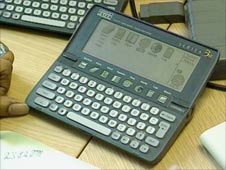 Mind you, the Revo still looked like a very capable mini-computer, the kind of device that might have one day evolved into a multimedia tablet. I had a series of Psion organisers and I remember making a far-sighted piece at the end of 1999 predicting that this fast-growing British firm might put the wind up Microsoft over the coming decade - well, we all make mistakes.
We asked Stuart Miles of Pocket Lint and Kat Hannaford of Gizmodo to think back to 2000 and try to remember what really excited them then about technology. Kat, who was 14 and living on a remote farm in Australia, was gripped by gaming:
"The Playstation 2 was coming out, but I had to wait a bit because it was quite expensive. And then there was the internet, which we didn't get until later that year."
Stuart, who was 24 and working as a technology correspondent for the Times, had just got himself an APS camera - which turned out to be an interim technology:
"Digital cameras were just starting to make their way onto the scene - 1 or 2 megapixels and very expensive - but the possibilities seemed endless."
In the last decade, we've seen all sorts of technologies become obsolete as the pace of change has accelerated.
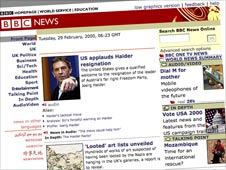 The cathode ray tube is becoming a distant memory for many as televisions have become flatter, bigger, and high definition. VHS has disappeared from most living rooms, to be replaced first by DVD, and perhaps now by Blu-Ray (though that too looks like an interim technology) and increasingly by IPTV such as the iPlayer. Big music systems with CD players and separate amplifiers are also vanishing quickly, with docks for portable players and streaming music devices popping up in many homes. And of course, more and more phones are now smartphones, with users rushing to install applications that help them run their lives or simply enjoy themselves on the move.
But, I asked my two pundits: if you had to choose a gadget of the decade, what would it be?
After a certain amount of umming and ahing, Stuart Miles came up with two:
"For me, it's either the launch of the Canon 300D - the first sub-£1,000 digital SLR camera, or the launch of Sky+ - as it's changed the way I watch television and freed me from the schedules."
For Kat, though, the real advance is the advent of high-definition technology:
"It's revolutionised all aspects of home entertainment. With the introduction of flat-screen HD TVs, the Blu-Ray format and subsequent players, and consoles like the Xbox 360 and PlayStation3 capable of playing the most brilliantly-detailed games, the quality of home viewing has changed forever."
Well, my two gadget pundits are very knowledgeable - but I'm afraid they're also both completely wrong. The "gadget" of the decade has to be the one thing that has made every other development possible - broadband.
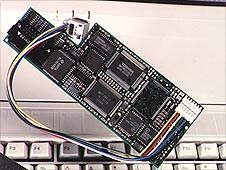 We started the Noughties listening to that annoying dial-up noise as we connected to the net at 56kbps; we ended it with nearly three quarters of British homes enjoying a permanent connection at up to 50Mbps, and increasing numbers able to enjoy mobile broadband at speeds home users would have killed for in 2000. We may moan about unsatisfactory broadband services, and look enviously at countries like South Korea - but living in a connected world became a reality in the Noughties.
The BBC is not responsible for the content of external internet sites
This is dot.life - a blog about technology from BBC News.
Rory Cellan-Jones is the BBC's technology correspondent.
Maggie Shiels is the BBC's tech reporter based in Silicon Valley.
Archive
« January 2010
| Sun | Mon | Tue | Wed | Thu | Fri | Sat |
|---|---|---|---|---|---|---|
| 1 | 2 | |||||
| 3 | 4 | 5 | 6 | 7 | 8 | 9 |
| 10 | 11 | 12 | 13 | 14 | 15 | 16 |
| 17 | 18 | 19 | 20 | 21 | 22 | 23 |
| 24 | 25 | 26 | 27 | 28 |
Being Discussed Now
- Logging out... and straight back in(3)
- Gadgets of the Noughties(20)
- Plastic Logic's long journey to Vegas(21)
- Sexting teens(17)
- Wikipedia on the wane?(49)
- 'Cooling-off' for mobile phones? Not on the High Street(37)
- 2009 - the social year(36)
- Twitter, Iran and #uksnow(25)
- Broadband Britain - how far down the league?(55)
- Microsoft and Murdoch: Teaming up to bash Google?(34)
BBC Technology Headlines
- %28none%29
%28none%29 - %28none%29
%28none%29 - %28none%29
%28none%29
Visit the Technology index
Visit the BBC News website
Rory's TV/Radio reports
- Residents block Google car
Broadcast: 3 April 2009 - New adverts to tackle film piracy
Broadcast: 2 April 2009 - Call to scrap 'illegal databases'
Broadcast: 23 March 2009 - Female robot takes to the catwalk
Broadcast: 16 March 2009 - Super-charged battery breakthrough
Broadcast: 12 March 2009

- News Editors
- Sport Editors
- Journalism Labs
- BBC Internet Blog
- Radio 4 Blog
- Peston's Picks
- Nick Robinson's Newslog
- Stephanomics
- Mark Easton's UK
- Mark Mardell's America
- Nick Bryant's Australia
- Andrew Harding on Africa
- Gavin Hewitt's Europe
- Soutik Biswas' India
- dot.Rory
- Science: Jonathan Amos
- Richard Black on environment
- Today: Tom Feilden
- Fergus Walsh's medical files
- Newsnight: Paul Mason
- Newsnight: Mark Urban
- Torin Douglas
- Will Gompertz's arts
- Phil Coomes on photojournalism
- Magazine Monitor
- Mark D'Arcy in Westminster
- NI: Mark Devenport
- Scotland: Brian Taylor
- Scotland: Douglas Fraser
- Wales: Betsan Powys
- Martin Rosenbaum on FOI
- 5 Live Breakfast
- Newsnight
- PM programme (iPM)
- World Tonight: Robin Lustig
