


Microsoft and Murdoch: Teaming up to bash Google?
- 23 Nov 09, 11:24 GMT
There's a fascinating story in this morning's edition of the Financial Times, which could signal a big shift in the balance of power between parts of the web and other parts of the media. The piece says that Microsoft has been in talks with the media giant News Corporation over a plan which could see the firm behind papers from the Wall Street Journal to the Sun being paid to stop Google searching its news websites.
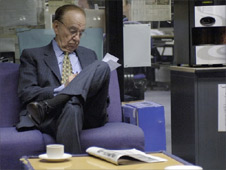 The implication is that Microsoft's search engine Bing would be the place to go for news - and that Google would have to start paying if it wanted to retain that kind of content.
The FT's story comes a week or so after the Techcrunch UK blog reported that Microsoft had held talks with European publishers about what sounds like a similar plan to get them onside as part of a battle to make Bing a more attractive and lucrative place than Google for their content.
So is there any truth in either report? Well, a couple of days after the Techcrunch post, I was due to interview a senior executive from Bing, and Microsoft called to ask whether I would be asking about that story. When I said yes I would, they said he could not talk about it - and we therefore pulled out of the interview. Make of that what you will.
All of this comes against the background of Rupert Murdoch's campaign to start getting people to pay for the online content of his newspapers, a move fleshed out last week in a speech by the editor of the Times, James Harding.
But Mr Murdoch has also made it clear that Google - and indeed the BBC - are two major obstacles to this campaign, because they are both major ways to get free news. Meanwhile, Microsoft is anxious to do two things - to give Bing a big push, and to get in on Google's profit margins.
So it's understandable that News Corp and Microsoft might want to unite against the idea that news content on the internet should be free. But there are also plenty of reasons why Microsoft in particular would want to keep these negotiations as quiet as possible.
After all, if internet users get it into their heads that Bing's results are not as unbiased as Google's appear to be, because of an alliance with news providers, then they may well be less keen to switch to Microsoft's search engine.
Ah, but what if Bing were the only place to get quality news because such content had been shut out of Google? Well, that would be an interesting test of just how important news is to the mass of internet users. For we professional journalists, that could be a worrying moment - one where we find out the true market value of our content.
Hi-tech hacks
- 23 Nov 09, 08:19 GMT
What kind of technology does the modern multimedia reporter need to master - and where is the boundary these days between the professionals and amateurs? Two questions I've been debating over the last couple of weeks with journalism students at the Cardiff School of Journalism, and with colleagues from other broadcasting organisations at a conference in Paris.
 The session at the Festival Europeen des 4 Ecrans was about multimedia journalism, and the challenge that poses to traditional media organisations. My presentation was about the way the BBC newsroom has been transformed by the integration of web, radio and TV journalists but also by the recognition that the audience has changed from passive recipients of news to eager contributors of everything from blog comments to video of breaking news stories. I showed a short video shot on a mobile phone to illustrate the importance of what we call the UGC (user-generated content) hub.
But it looks as though some broadcasters are going even further in getting the audience to do the journalism. Vincent Giret from France 24, a trilingual news channel running services in French, English and now Arabic, described an experiment called "The Observers". The channel has recruited about 2,000 people from around the world who send in short video reports - everything from footage of a bomb going off in Baghdad to an Irishman giving his views on the Thierry Henry "main de Dieu" incident.
There was some sharp questioning from the floor about whether these "citizen journalists" are paid - they're not - and how France 24 can be sure about the authenticity of their reports. Vincent Giret insisted that there was still a rigorous editorial process before anything was shown on TV or on the website.
Then we heard from a man who seems to me the very model of a modern multimedia journalist. Damien Van Achter works for the Belgian TV station RTBF - and his card describes him as community manager, editor developer and journalist. But his role seems to be to act as a kind of new media agent provocateur inside quite a traditional organisation, encouraging older broadcasters to try all the new tools that are now available.
Even while we were setting up our laptops for our presentations he was using tools like Audioboo to record and upload sound to the web, putting video from his phone online within seconds, then showing me how he uses an iPhone app to edit his videos, inserting titles and effects.
His blog, "Blogging the News", is where he brings a lot of his journalist experiments together but it seems most of it is his own rather than RTBF's material - he's really a backroom boy at the station rather than a mainstream correspondent. All the more interesting then that the US State Department, which had spotted his blog, contacted him before Hillary Clinton's visit to Brussels and offered him exclusive access to the secretary of state during her tour.
He seemed just a bit defensive when I asked how the political or diplomatic correspondents at RTBF had greeted this news - he insisted they did the professional job of analysing the politics of the trip, while he provided access and colour, which you can see here.
Now I have struggled to acquire just a few of the multimedia skills that Damien van Achter has in abundance, and while I feel they've enriched my journalism and made my life a lot more interesting, I do think that there are questions to be asked about whether the modern professional journalist can do absolutely everything. If a reporter has to shoot and edit video, record audio and take a few stills, will they still have time to do those age-old journalistic tasks of ringing people up, asking them questions and getting to the bottom of an original story?
The student journalists I met in Cardiff all seemed incredibly talented and multi-skilled - they'd come from a morning in the courts learning about law reporting, but were eager to discuss everything from the way Google Wave might change journalism to which iPhone apps were best suited to mobile reporting. They were bravely preparing themselves to enter a profession in crisis, where the very idea of paying people to do journalism appears to be under threat.
I told them that it was great to learn a wide set of skills, but that news editors would not want to employ someone who could just about shoot a video, muddle their way through a court story, and slap together a few minutes of unpolished audio. They would rather have someone who was brilliant at one thing and they still cared about the fundamentals of journalism. Spotting a story, crafting a powerful intro, telling people something they didn't know - these skills have not been rendered obsolete by the web revolution.
At least I hope that is true. But the big question is whether we will be willing to pay for the craft of journalism - either the old kind or today's multimedia variety - in the coming decade. New technology, from blogging software to YouTube to iPhone apps, is making it possible for anyone, amateur or professional, to make news and give it to the world. What's becoming ever harder is working out how to make a living from journalism.
The BBC is not responsible for the content of external internet sites
This is dot.life - a blog about technology from BBC News.
Rory Cellan-Jones is the BBC's technology correspondent.
Maggie Shiels is the BBC's tech reporter based in Silicon Valley.
Archive
« January 2010
| Sun | Mon | Tue | Wed | Thu | Fri | Sat |
|---|---|---|---|---|---|---|
| 1 | 2 | |||||
| 3 | 4 | 5 | 6 | 7 | 8 | 9 |
| 10 | 11 | 12 | 13 | 14 | 15 | 16 |
| 17 | 18 | 19 | 20 | 21 | 22 | 23 |
| 24 | 25 | 26 | 27 | 28 |
Being Discussed Now
- Logging out... and straight back in(3)
- Gadgets of the Noughties(20)
- Plastic Logic's long journey to Vegas(21)
- Sexting teens(17)
- Wikipedia on the wane?(49)
- 'Cooling-off' for mobile phones? Not on the High Street(37)
- 2009 - the social year(36)
- Twitter, Iran and #uksnow(25)
- Broadband Britain - how far down the league?(55)
- Microsoft and Murdoch: Teaming up to bash Google?(34)
BBC Technology Headlines
- %28none%29
%28none%29 - %28none%29
%28none%29 - %28none%29
%28none%29
Visit the Technology index
Visit the BBC News website
Rory's TV/Radio reports
- Residents block Google car
Broadcast: 3 April 2009 - New adverts to tackle film piracy
Broadcast: 2 April 2009 - Call to scrap 'illegal databases'
Broadcast: 23 March 2009 - Female robot takes to the catwalk
Broadcast: 16 March 2009 - Super-charged battery breakthrough
Broadcast: 12 March 2009

- News Editors
- Sport Editors
- Journalism Labs
- BBC Internet Blog
- Radio 4 Blog
- Peston's Picks
- Nick Robinson's Newslog
- Stephanomics
- Mark Easton's UK
- Mark Mardell's America
- Nick Bryant's Australia
- Andrew Harding on Africa
- Gavin Hewitt's Europe
- Soutik Biswas' India
- dot.Rory
- Science: Jonathan Amos
- Richard Black on environment
- Today: Tom Feilden
- Fergus Walsh's medical files
- Newsnight: Paul Mason
- Newsnight: Mark Urban
- Torin Douglas
- Will Gompertz's arts
- Phil Coomes on photojournalism
- Magazine Monitor
- Mark D'Arcy in Westminster
- NI: Mark Devenport
- Scotland: Brian Taylor
- Scotland: Douglas Fraser
- Wales: Betsan Powys
- Martin Rosenbaum on FOI
- 5 Live Breakfast
- Newsnight
- PM programme (iPM)
- World Tonight: Robin Lustig
