


Google Books: The latest chapter
- 16 Nov 09, 17:49 GMT
Reading the coverage over the last couple of days, you might think that the row over Google's plans to digitise the world's books was fading away.
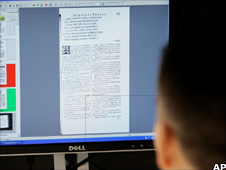 The search company has responded to the anger of many in the publishing world by making concessions late last week which mean that most non-American titles will not be included. "Google backtracks on putting world's books online," read one headline today.
But actually it's a lot more complicated than that, as I discovered in the genteel surroundings of the Society of Authors in Kensington this lunchtime.
Representatives of publishers and authors in the US and UK had called a few journalists together to explain some of the details of this extraordinarily complex deal.
After an hour I think I might just about have got to grips with it - but let's boil it down to a few headlines.
• The deal envisages the digitisation of millions of out-of-print works that are in libraries in the United States.
• The number of books involved has now come down by 60%, following the decision to exclude most foreign language books.
• But books by UK, Australian and Canadian authors held in US libraries will be part of the programme, unless the authors or publishers opt out.
• Google users outside the United States will not have access to the service.
What was clear from the meeting was that the bodies representing US and UK authors and publishers are united in the belief that the deal is now satisfactory and should go through.
The Authors' Licensing and Collecting Society, which collects fees for writers, says it has received around 2,000 positive e-mails from its members, with only four or five opposed to the settlement.
But, I asked how could they all be so sanguine about the prospect of giving Google a foothold in online publishing which might eventually make an already powerful company the dominant force in the future of books?
They insisted that a deal involving out-of-print titles, a sector of the market which was by definition unprofitable, would not set a precedent: "Nobody expects the settlement to be the mechanism to make in-print books available to the general public," said Paul Aiken of the US Authors Guild.
He then picked up his copy of Amazon's e-book the Kindle to make the point that monopoly power currently resided elsewhere:
"Amazon has 90% of the e-book market in the United States, and 75% of the online print book market - Google has roughly 0%. Google entering the market for out-of-print books just isn't going to change the equation."
Simon Juden of the UK Publishers said that he and his colleagues across Europe were working on Arrow, an EU-funded system for putting out-of-print books online, which would be "much more platform-neutral".
Why, then, had his organisation backed this system which was so far from being neutral? "We sit where we sit," he replied, "to get where we are we started with a court action in 2005. In the real world, this is just where we are."
And one other thing is very clear - this story will have many more chapters. Even if the current settlement finally gets the approval of the US court, it may not come into force for some years.
"There are implacable opponents with money and they will appeal it," said the man from the US Publishers Association. So, who knows, perhaps a European online book platform could be up and running while Google's version remains trapped inside the American legal system.
The anonymous bullies
- 16 Nov 09, 08:34 GMT
Shocking figures today on the extent of cyberbullying in our schools. Research for the charity Beatbullying showed that over 60% of 11-18-year-olds said they'd witnessed some form of online bullying. It ranges from unkind words on an instant messaging service to full-blown hate campaigns which in extreme cases have driven some children to suicide.
 But, as we shake our heads and ask ourselves how it came to this, shouldn't we also be asking another question: are adults any better?
You don't have to roam far online to find examples of rudeness, aggression and downright bullying. I had a quick scan of the politics blogs - left and right - this morning and these were just a few of the comments I found:
"He should be hung drawn and quartered, as slowly as is possible to maximise his suffering."
"This EVIL person deserves no pity. He is accomplished in one thing only. Utter Cowardice."
"The rest of Parliament should be shot, not hung."
But it's not just politics that is discussed online with this level of vituperation. Almost any area of life - from religion, to the environment to literature - seems capable of attracting those, who when sat in front of a computer, will tap out messages of hate that they would never be likely to express face-to-face with their opponents.
Even a subject that most might see as fairly innocuous, such as which computer operating system might be the best, can spark furious exchanges amongst people who attack each others' credentials, motives, professionalism - or right to exist.
And what do nearly all of these angry people have in common? They are anonymous, leaving just a nom de guerre scattered across various blogs and message boards. Now, anonymity is a vital protection for those who want to protest against the Iranian authorities or reveal malpractice by their employer - or to talk about their own experiences at the hands of school bullies.
But should we have any respect for anyone who launches wounding attacks without having the courage to reveal their own identity? No - arguably not in the playground, nor on an instant messaging service, or anywhere online.
The BBC is not responsible for the content of external internet sites
This is dot.life - a blog about technology from BBC News.
Rory Cellan-Jones is the BBC's technology correspondent.
Maggie Shiels is the BBC's tech reporter based in Silicon Valley.
Archive
« January 2010
| Sun | Mon | Tue | Wed | Thu | Fri | Sat |
|---|---|---|---|---|---|---|
| 1 | 2 | |||||
| 3 | 4 | 5 | 6 | 7 | 8 | 9 |
| 10 | 11 | 12 | 13 | 14 | 15 | 16 |
| 17 | 18 | 19 | 20 | 21 | 22 | 23 |
| 24 | 25 | 26 | 27 | 28 |
Being Discussed Now
- Logging out... and straight back in(3)
- Gadgets of the Noughties(20)
- Plastic Logic's long journey to Vegas(21)
- Sexting teens(17)
- Wikipedia on the wane?(49)
- 'Cooling-off' for mobile phones? Not on the High Street(37)
- 2009 - the social year(36)
- Twitter, Iran and #uksnow(25)
- Broadband Britain - how far down the league?(55)
- Microsoft and Murdoch: Teaming up to bash Google?(34)
BBC Technology Headlines
- %28none%29
%28none%29 - %28none%29
%28none%29 - %28none%29
%28none%29
Visit the Technology index
Visit the BBC News website
Rory's TV/Radio reports
- Residents block Google car
Broadcast: 3 April 2009 - New adverts to tackle film piracy
Broadcast: 2 April 2009 - Call to scrap 'illegal databases'
Broadcast: 23 March 2009 - Female robot takes to the catwalk
Broadcast: 16 March 2009 - Super-charged battery breakthrough
Broadcast: 12 March 2009

- News Editors
- Sport Editors
- Journalism Labs
- BBC Internet Blog
- Radio 4 Blog
- Peston's Picks
- Nick Robinson's Newslog
- Stephanomics
- Mark Easton's UK
- Mark Mardell's America
- Nick Bryant's Australia
- Andrew Harding on Africa
- Gavin Hewitt's Europe
- Soutik Biswas' India
- dot.Rory
- Science: Jonathan Amos
- Richard Black on environment
- Today: Tom Feilden
- Fergus Walsh's medical files
- Newsnight: Paul Mason
- Newsnight: Mark Urban
- Torin Douglas
- Will Gompertz's arts
- Phil Coomes on photojournalism
- Magazine Monitor
- Mark D'Arcy in Westminster
- NI: Mark Devenport
- Scotland: Brian Taylor
- Scotland: Douglas Fraser
- Wales: Betsan Powys
- Martin Rosenbaum on FOI
- 5 Live Breakfast
- Newsnight
- PM programme (iPM)
- World Tonight: Robin Lustig
