


Who wants to live in Vodafone's world?
- 24 Sep 09, 12:24 GMT
Whose world do you live in? Where do you keep your increasingly unmanageable pile of data - contacts, e-mails, photos, browser bookmarks? For years, the likes of Microsoft and Apple tried to persuade us to live exclusively with them, while various web businesses - from Yahoo to AOL to Google - invited us round to their places and suggested that the more time we spent with them, the happier we would be.
Now the mobile industry, whose customers have been pretty promiscuous up to now, is doing its best to persuade us to settle down in their world. Nokia has already started offering everything from music to an app store. Today Vodafone launched something called 360 at a big glitzy event in a converted tramshed in East London.
Confused by all the free smoothies and muffins, the glossy video and marketing material, battered with "compelling" and "exciting" buzzwords, it took me some time to work out what 360 was all about. "Today is the first step in making the internet more personal," left me no clearer.
Ah, I get it. It's about synchronising your contacts, your calendar, your e-mails, on your phone and on your desktop, PC or Mac.
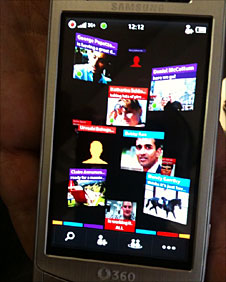 It also involves a range of new devices from the likes of Samsung featuring the 360 service. At the heart of it is a so-called "dynamic" address book, which shows all of your contacts' various numbers and social networking details, and brings floating to the front those you've engaged with most recently.
But just a minute, surely I can do that already through say Apple's MobileMe, or Google Sync, or Windows Live Sync? And new phones based on the Android operating system do the same clever tricks with your contacts book.
Ah, but there's more. With Vodafone maps, on which you could enter data such as favourite restaurants, an app store, and a music service - a "very compelling music experience". And you can search the phone and quickly discover anything stored on it, or out on the web.
It all looked pretty smart - but why would you want to do all this in Vodafone's world, when you can already do it elsewhere?
The company's chief executive Vittorio Colao made a good point about the relationship between consumers and their mobile operators: "Customers trust us... they allow us to take small amounts of money out of their pockets every day."
And, while 360 will only be launched in eight European countries before Christmas, he's betting that a large slice of Vodafone's 300 million customers around the world will eventually sign up. What's more there's a big pitch to content providers still looking rather desperately for ways to make money in a web world.
"Everybody who digitises - we can help them monetise," he explained. One example, a Spanish newspaper developing exclusive content for 360 users. So was it about holding on to customers or earning new revenues, asked one journalist at the launch. It seems they go together - if you can hold on to more customers, they will generate more data traffic and that will boost revenues.
It's pretty clear why Vodafone has put so much effort into its 360 offering. As voice revenues dwindle, data is where it's at. But here's a question: have you ever met someone who identifies themself a a Vodafone fan - rather than a Google groupie, a Machead or a Windows true believer? I'm not entirely convinced that there's a huge crowd desperate to live in a Vodafone world - but there's a lot of money riding on the success of venture, so maybe it will work.
The BBC is not responsible for the content of external internet sites
This is dot.life - a blog about technology from BBC News.
Rory Cellan-Jones is the BBC's technology correspondent.
Maggie Shiels is the BBC's tech reporter based in Silicon Valley.
Archive
« January 2010
| Sun | Mon | Tue | Wed | Thu | Fri | Sat |
|---|---|---|---|---|---|---|
| 1 | 2 | |||||
| 3 | 4 | 5 | 6 | 7 | 8 | 9 |
| 10 | 11 | 12 | 13 | 14 | 15 | 16 |
| 17 | 18 | 19 | 20 | 21 | 22 | 23 |
| 24 | 25 | 26 | 27 | 28 |
Being Discussed Now
- Logging out... and straight back in(3)
- Gadgets of the Noughties(20)
- Plastic Logic's long journey to Vegas(21)
- Sexting teens(17)
- Wikipedia on the wane?(49)
- 'Cooling-off' for mobile phones? Not on the High Street(37)
- 2009 - the social year(36)
- Twitter, Iran and #uksnow(25)
- Broadband Britain - how far down the league?(55)
- Microsoft and Murdoch: Teaming up to bash Google?(34)
BBC Technology Headlines
- %28none%29
%28none%29 - %28none%29
%28none%29 - %28none%29
%28none%29
Visit the Technology index
Visit the BBC News website
Rory's TV/Radio reports
- Residents block Google car
Broadcast: 3 April 2009 - New adverts to tackle film piracy
Broadcast: 2 April 2009 - Call to scrap 'illegal databases'
Broadcast: 23 March 2009 - Female robot takes to the catwalk
Broadcast: 16 March 2009 - Super-charged battery breakthrough
Broadcast: 12 March 2009

- News Editors
- Sport Editors
- Journalism Labs
- BBC Internet Blog
- Radio 4 Blog
- Peston's Picks
- Nick Robinson's Newslog
- Stephanomics
- Mark Easton's UK
- Mark Mardell's America
- Nick Bryant's Australia
- Andrew Harding on Africa
- Gavin Hewitt's Europe
- Soutik Biswas' India
- dot.Rory
- Science: Jonathan Amos
- Richard Black on environment
- Today: Tom Feilden
- Fergus Walsh's medical files
- Newsnight: Paul Mason
- Newsnight: Mark Urban
- Torin Douglas
- Will Gompertz's arts
- Phil Coomes on photojournalism
- Magazine Monitor
- Mark D'Arcy in Westminster
- NI: Mark Devenport
- Scotland: Brian Taylor
- Scotland: Douglas Fraser
- Wales: Betsan Powys
- Martin Rosenbaum on FOI
- 5 Live Breakfast
- Newsnight
- PM programme (iPM)
- World Tonight: Robin Lustig
