


Will T'Orange be good for shoppers?
- 8 Sep 09, 14:02 GMT
Today's deal which would see a merger between Orange and T-Mobile in the UK is obviously sending tremors through the mobile industry - and it's causing further excitement amongst investment bankers who've now see two huge corporate deals in two days after yesterday's news that Kraft wants to gobble up Cadbury. But, to ask the classic question often thrown at me by news editors - what does it mean for shoppers?
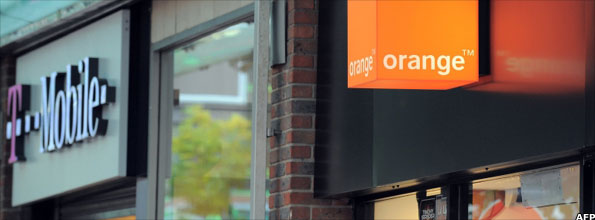
In other words, will mobile phone customers be better or worse off, once they can only choose from four operators rather than five? At first sight, it's bad news - surely one business with 28 million customers and 37% of the UK market will have too much power to influence the price and availability of mobile phone contracts?
When I sent a frivolous e-mail to one high-powered European telecoms analyst asking about the implications for shoppers, back came this reply: "The risk for shoppers is to see less competition and less favourable prices on the UK market."
So presumably the various regulators - at the EU, the Office of Fair Trading, and Ofcom - will step in to stop this deal from going ahead?
Well, those I've spoken to in the industry this morning think not. Yes, they'll all run the rule over "T'Orange", as some wags have already christened it, and they may even demand that bits of the business are sold off.
But in the words of one big UK operator, "consolidation works for everybody". His argument went like this - we already have a more competitive market than in any other European country. France has just three big operators, Spain four, and in Germany the two biggest players have more than 80% of the market.
A merger would leave Britain with three chunky players - Vodafone, O2 and T'Orange - with Three still hanging in there and desperately trying to provide customers with something innovative to make an impact.
Then there are the MVNOs - mobile virtual network operators - like Tesco and Virgin, who will continue to invigorate the market with some fresh ideas.
In chimed an analyst, with thoughts about the level of competition in the UK as desperate operators tried to lure the shoppers with ever more complex offers. "The UK market had an unbelievable 500 new deals activated in June," Brad Rees of Mediacells told me. His argument was that if the merger reduced this "tsunami" of offers it might actually be easier for customers to get to grips with the market.
Cut-throat competition, argued another contact, wasn't necessarily good for investment either. It had left the industry as a whole, unwilling to spend the sums necessary to build better networks. That point certainly rings true - as more and more of us start using the mobile internet, the strains on the networks are becoming ever clearer. Neither T-Mobile nor Orange has been that successful in the fast-growing mobile broadband area - perhaps their joint network will now be able to offer some real competition to Vodafone, currently the leader in this area.
So the message seemed to be that we will see fewer shops cluttering up every high street with confusing mobile deals, fewer but better phone masts, and an industry able to concentrate on improving customer service. In fact, as I made my calls around the mobile industry, it was hard to find anyone who thought that this merger was a bad thing - even rival operators seemed relieved that the long period of uncertainty over T-Mobile's future in the UK was coming to an end.
But perhaps that unanimity should send a few warning signals to shoppers. After all Vodafone - which you might presume would be one of the big losers from this deal - saw its shares rise this morning, with the market apparently betting that less competition would be better for everyone's profits.
So the market has decided the future's bright for T'Orange and the whole mobile phone industry - but whether that is quite such good news for shoppers remains to be seen.
The BBC is not responsible for the content of external internet sites
This is dot.life - a blog about technology from BBC News.
Rory Cellan-Jones is the BBC's technology correspondent.
Maggie Shiels is the BBC's tech reporter based in Silicon Valley.
Archive
« January 2010
| Sun | Mon | Tue | Wed | Thu | Fri | Sat |
|---|---|---|---|---|---|---|
| 1 | 2 | |||||
| 3 | 4 | 5 | 6 | 7 | 8 | 9 |
| 10 | 11 | 12 | 13 | 14 | 15 | 16 |
| 17 | 18 | 19 | 20 | 21 | 22 | 23 |
| 24 | 25 | 26 | 27 | 28 |
Being Discussed Now
- Logging out... and straight back in(3)
- Gadgets of the Noughties(20)
- Plastic Logic's long journey to Vegas(21)
- Sexting teens(17)
- Wikipedia on the wane?(49)
- 'Cooling-off' for mobile phones? Not on the High Street(37)
- 2009 - the social year(36)
- Twitter, Iran and #uksnow(25)
- Broadband Britain - how far down the league?(55)
- Microsoft and Murdoch: Teaming up to bash Google?(34)
BBC Technology Headlines
- %28none%29
%28none%29 - %28none%29
%28none%29 - %28none%29
%28none%29
Visit the Technology index
Visit the BBC News website
Rory's TV/Radio reports
- Residents block Google car
Broadcast: 3 April 2009 - New adverts to tackle film piracy
Broadcast: 2 April 2009 - Call to scrap 'illegal databases'
Broadcast: 23 March 2009 - Female robot takes to the catwalk
Broadcast: 16 March 2009 - Super-charged battery breakthrough
Broadcast: 12 March 2009

- News Editors
- Sport Editors
- Journalism Labs
- BBC Internet Blog
- Radio 4 Blog
- Peston's Picks
- Nick Robinson's Newslog
- Stephanomics
- Mark Easton's UK
- Mark Mardell's America
- Nick Bryant's Australia
- Andrew Harding on Africa
- Gavin Hewitt's Europe
- Soutik Biswas' India
- dot.Rory
- Science: Jonathan Amos
- Richard Black on environment
- Today: Tom Feilden
- Fergus Walsh's medical files
- Newsnight: Paul Mason
- Newsnight: Mark Urban
- Torin Douglas
- Will Gompertz's arts
- Phil Coomes on photojournalism
- Magazine Monitor
- Mark D'Arcy in Westminster
- NI: Mark Devenport
- Scotland: Brian Taylor
- Scotland: Douglas Fraser
- Wales: Betsan Powys
- Martin Rosenbaum on FOI
- 5 Live Breakfast
- Newsnight
- PM programme (iPM)
- World Tonight: Robin Lustig
