


Microsoft: There's a buzz about Bing
- 31 Jul 09, 16:29 GMT
I've spent some time in recent days with Microsoft executives in the UK, and there's a surprising spring in their step.
Surprising, because these are not great days for the software behemoth, having just suffered its first annual drop in revenues in its history, as its major corporate customers cut back on their spending on products like Windows and Office.
But the executives I met were keen to stress a switch in focus from businesses to consumers. They appear to have woken up to the fact that Vista caused such a wave of disappointment among many users that severe damage was done to the company's image - and they say they're determined to do better.
They pointed to all sorts of stats showing how great an engagement their company had with UK consumers - 21 million Hotmail users; 17 million Messenger users; 16 million visitors to the MSN homepage each month. They enthused about some good reviews and record pre-order figures for Windows 7, due out in late October.
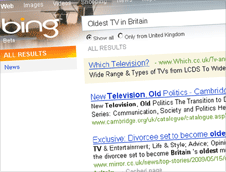 But what really seemed to have cheered them up was the reception for their new search engine Bing - now doubly important after the deal with Yahoo.
They claimed that it was delighting users and had enjoyed better traffic than expected. A quick call to Nielsen Netratings told me that Bing hadn't actually made much of an impact in its first month - 84% of all searches in the UK in June were done with Google while Bing had just 3.3% of the market. And while I had had a quick go when the new search engine was launched, I've since reverted to Google - a familiar pattern, I suspect.
But I decided to give Bing another shot, comparing it with Google on a few searches which seemed to reflect my interests today.
(1) Ricky Ponting Test Batting Average
Both sites gave Ponting's Wikipedia entry as their first result, but Bing gave more of the entry in its result, showing the Australian batsman's average at 56.31.
No great difference between the two.
(2) Mallorca beaches north coast
Google's top result here was about one particular resort - not very useful. But Bing found a site about the north-east coast, and a feature that allows you to hover over the link, and see some of the text, proving the site was worth a visit.
(3) Oldest TV in Britain
The first result in Google took me immediately to the BBC story last week about Britain's oldest working television. I then clicked on video, and found it surprisingly hard to find a working version of the short video piece we made, though it turned up eventually.
But Bing failed completely on its first page of results, showing all sorts of random links - everything from books about television and politics, to an article about Britian's oldest mother.
Then I clicked on video. It's the video search that is definitely Bing's best feature, allowing you to hover over each clip and see it starting to play before deciding which one you want.
My search threw up a bizarre collection of clips - mostly from Britain's Got Talent - though it eventually tracked down some shots of the oldest telly.
(4) Pound v Euro
Neither Google nor Bing produced instant answers on the current exchange rate. So I went to Wolfram Alpha for the first time in weeks, and found one good use of the computational knowledge engine.
So it's a bit of a mixed picture. Bing certainly has some nice features, but it's by no means clear to me that it does a much better job than Google. And of course it not only has to be better - it has to prove so much more useful that it overcomes the inertia of the 84% of UK internet users who search with Google.
It's always nice to see people happy in their work, but those Microsoft executives still have some work to do in turning their business into the cool, consumer-friendly brand they seem to think it deserves to be.
As you may have guessed from one of my searches, I'm now off on holiday for a couple of weeks. I'm sure there'll be plenty to catch up on when I get back.
The BBC is not responsible for the content of external internet sites
This is dot.life - a blog about technology from BBC News.
Rory Cellan-Jones is the BBC's technology correspondent.
Maggie Shiels is the BBC's tech reporter based in Silicon Valley.
Archive
« January 2010
| Sun | Mon | Tue | Wed | Thu | Fri | Sat |
|---|---|---|---|---|---|---|
| 1 | 2 | |||||
| 3 | 4 | 5 | 6 | 7 | 8 | 9 |
| 10 | 11 | 12 | 13 | 14 | 15 | 16 |
| 17 | 18 | 19 | 20 | 21 | 22 | 23 |
| 24 | 25 | 26 | 27 | 28 |
Being Discussed Now
- Logging out... and straight back in(3)
- Gadgets of the Noughties(20)
- Plastic Logic's long journey to Vegas(21)
- Sexting teens(17)
- Wikipedia on the wane?(49)
- 'Cooling-off' for mobile phones? Not on the High Street(37)
- 2009 - the social year(36)
- Twitter, Iran and #uksnow(25)
- Broadband Britain - how far down the league?(55)
- Microsoft and Murdoch: Teaming up to bash Google?(34)
BBC Technology Headlines
- %28none%29
%28none%29 - %28none%29
%28none%29 - %28none%29
%28none%29
Visit the Technology index
Visit the BBC News website
Rory's TV/Radio reports
- Residents block Google car
Broadcast: 3 April 2009 - New adverts to tackle film piracy
Broadcast: 2 April 2009 - Call to scrap 'illegal databases'
Broadcast: 23 March 2009 - Female robot takes to the catwalk
Broadcast: 16 March 2009 - Super-charged battery breakthrough
Broadcast: 12 March 2009

- News Editors
- Sport Editors
- Journalism Labs
- BBC Internet Blog
- Radio 4 Blog
- Peston's Picks
- Nick Robinson's Newslog
- Stephanomics
- Mark Easton's UK
- Mark Mardell's America
- Nick Bryant's Australia
- Andrew Harding on Africa
- Gavin Hewitt's Europe
- Soutik Biswas' India
- dot.Rory
- Science: Jonathan Amos
- Richard Black on environment
- Today: Tom Feilden
- Fergus Walsh's medical files
- Newsnight: Paul Mason
- Newsnight: Mark Urban
- Torin Douglas
- Will Gompertz's arts
- Phil Coomes on photojournalism
- Magazine Monitor
- Mark D'Arcy in Westminster
- NI: Mark Devenport
- Scotland: Brian Taylor
- Scotland: Douglas Fraser
- Wales: Betsan Powys
- Martin Rosenbaum on FOI
- 5 Live Breakfast
- Newsnight
- PM programme (iPM)
- World Tonight: Robin Lustig
