


Hull is heaven... unless you're a file-sharer
- 24 Jul 09, 17:07 GMT
Hull is heaven. That must be what some people in the music and movie industries were thinking this morning. They've been pressing internet service providers to take strong action against illegal file-sharing - with very little success to date.
Then it emerged that a broadband supplier in Hull was going even further than the copyright owners could have hoped. Karoo has been disconnecting people without warning, for offences such as downloading a movie using BitTorrent. Never mind three strikes and you're out - the policy that France has introduced amidst huge controversy and the UK government rejected in its Digital Britain report - this was one strike and you're out.
No other ISP in Britain has gone this far, and when I called the Internet Service Providers' Association they seemed taken aback. Even the music industry body, the BPI, seemed lost for words, merely suggesting that it was up to each firm to decide how to confront this issue. I'd suggested that they might like to relocate their headquarters - and those of the major record labels - to Hull as a gesture of gratitude.
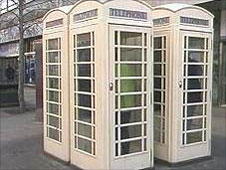 But, I hear you ask, why don't Karoo's customers will simply up sticks and choose another broadband provider? Well, they can't - Karoo is the only one in town, owned by Kingston Communications, the company with the white phone boxes that has long been an anomaly in the UK's telecoms scene. Kingston has a monopoly, and while in theory other firms could come and share its exchange, they haven't chosen to do so.
Then tonight, there was a U-turn. After a day of publicity, following the excellent reporting of this story by my colleagues at BBC Radio Humberside, the company changed its policy.
"It's evident we have been exceeding the expectations of copyright owners, the media and internet users," said its statement.
So there'll be no more instant disconnections - though customers who ignore three written warnings will still face temporary suspension. That's still a tougher stance than just about any other ISP follows.
So we've seen what happens when one company has monopoly power - it can decide for itself how to operate. But we've also seen how much power angry consumers can wield when they believe that an injustice has been committed.
Spinvox sends a message
- 24 Jul 09, 11:33 GMT
Our story yesterday about Spinvox - and the fact that much of its work in transcribing voicemails is done by humans rather than machines - made some waves. A number of users who had imagined that the service was all about clever software seemed mildly shocked and surprised to find out that they were often being read by call centre workers in the Philippines or India.
 Others in the technology world said it had been known for years so what was the big deal. But Spinvox took the whole issue very seriously. Last night it put up a blog post describing my story as "incorrect and inaccurate" - but the company also invited me on a tour of its headquarters with the chance to see the technology behind its Voice Message Conversion System.
Christina Domecq, the company's co-founder came on the radio, talking to PM's Eddie Mair. He repeatedly pressed her on our central claim, that the majority of calls were read by humans rather than machines, but she maintained the company's line that this was a complex matter with no simple answer - the system learned as it went along, so that all of her messages, for instance, would be read by machine.
Later, she told the Guardian "The ratio of humans to messages and humans to number of users is very, very low." and "The majority of calls are fully automated."
Well I can only repeat what I've been told - and seen evidence to substantiate - that the majority of calls are in fact heard and transcribed by staff in call centres.
Christina Domecq also explained to the Guardian that as Spinvox ramped up from 30 to 100 million customers worldwide, it would be simply impossible to get human beings to do the job. That doesn't quite mesh with this quote from an interview with the paidcontent site, which has written extensively about Spinvox: "When we're going through massive growth, like we are now, we need more agents," she told the site in a lengthy interview. "A lot of Latin American dialects are new for us".
So what are they saying? That massive growth means the machines have to do most of the work - or that Spinvox has to recruit more call centre staff?
Late yesterday, someone pointed me to an advert on a site called offshoreexperts.com, where Spinvox appears to be seeking tenders for new call centre operations. It says that Spinvox "is currently in need of some significant support with our voice-to-text transcription services."
It outlines the nature of the work and then concludes:
"We would initially require you to provide us with c.50 agent workstations 24/7 for a 3 month trial, which if successful would lead to a 2/3 year long term commercial deal with significant ramp-up of agent resource numbers."
No very obvious sign there of a rapid move towards full automation.
And people I've spoken to in the speech recognition industry over recent days are largely of the view that Spinvox has set itself an impossible task. One firm also trying to provide a voicemail conversion service told me that if the company could really achieve the full automation to which Christina Domecq aspires, "it would be making money hand over fist." Its latest reported figures show it's a long way from that.
And Ian Turner, European MD of Nuance, the firm behind the Dragon brand of speech recognition products, told me a bit about his business. He explained a system where doctors dictate patient notes and prescriptions at high speed, and the computer-generated text is checked by a medical secretary.
That delivered very high levels of accuracy, he explained, but converting into text lots of different voices shouting down phone lines in different accents and languages was a much greater challenge: "This is serious deep engineering to build this stuff which takes years." And he said he'd seen no evidence that Spinvox were ahead of the game in this area.
Mr Turner also said that companies engaged in this work needed to be careful about data storage and transparent about their methods:"You have to be honest about this... in the current climate about data privacy, being transparent is absolutely critical."
By the way, I've written back to Spinvox accepting their kind invitation to come and see their systems close-up. But I've said the BBC would also like to see their overseas call centres. I'll let you know how they respond.
The BBC is not responsible for the content of external internet sites
This is dot.life - a blog about technology from BBC News.
Rory Cellan-Jones is the BBC's technology correspondent.
Maggie Shiels is the BBC's tech reporter based in Silicon Valley.
Archive
« January 2010
| Sun | Mon | Tue | Wed | Thu | Fri | Sat |
|---|---|---|---|---|---|---|
| 1 | 2 | |||||
| 3 | 4 | 5 | 6 | 7 | 8 | 9 |
| 10 | 11 | 12 | 13 | 14 | 15 | 16 |
| 17 | 18 | 19 | 20 | 21 | 22 | 23 |
| 24 | 25 | 26 | 27 | 28 |
Being Discussed Now
- Logging out... and straight back in(3)
- Gadgets of the Noughties(20)
- Plastic Logic's long journey to Vegas(21)
- Sexting teens(17)
- Wikipedia on the wane?(49)
- 'Cooling-off' for mobile phones? Not on the High Street(37)
- 2009 - the social year(36)
- Twitter, Iran and #uksnow(25)
- Broadband Britain - how far down the league?(55)
- Microsoft and Murdoch: Teaming up to bash Google?(34)
BBC Technology Headlines
- %28none%29
%28none%29 - %28none%29
%28none%29 - %28none%29
%28none%29
Visit the Technology index
Visit the BBC News website
Rory's TV/Radio reports
- Residents block Google car
Broadcast: 3 April 2009 - New adverts to tackle film piracy
Broadcast: 2 April 2009 - Call to scrap 'illegal databases'
Broadcast: 23 March 2009 - Female robot takes to the catwalk
Broadcast: 16 March 2009 - Super-charged battery breakthrough
Broadcast: 12 March 2009

- News Editors
- Sport Editors
- Journalism Labs
- BBC Internet Blog
- Radio 4 Blog
- Peston's Picks
- Nick Robinson's Newslog
- Stephanomics
- Mark Easton's UK
- Mark Mardell's America
- Nick Bryant's Australia
- Andrew Harding on Africa
- Gavin Hewitt's Europe
- Soutik Biswas' India
- dot.Rory
- Science: Jonathan Amos
- Richard Black on environment
- Today: Tom Feilden
- Fergus Walsh's medical files
- Newsnight: Paul Mason
- Newsnight: Mark Urban
- Torin Douglas
- Will Gompertz's arts
- Phil Coomes on photojournalism
- Magazine Monitor
- Mark D'Arcy in Westminster
- NI: Mark Devenport
- Scotland: Brian Taylor
- Scotland: Douglas Fraser
- Wales: Betsan Powys
- Martin Rosenbaum on FOI
- 5 Live Breakfast
- Newsnight
- PM programme (iPM)
- World Tonight: Robin Lustig
