


Networks and the iPhone
- 17 Jul 09, 09:48 GMT
Will I test your patience if I try to answer a few questions about the future of Apple's iPhone in the UK?
Is O2 about to lose its exclusive contract for the phone? Is there any truth in the rumours that Orange or T-Mobile or Vodafone are testing the phone on their networks because they are about to get a deal from Apple? And finally does anybody care?
The answer to the first question is no - at least not until November when O2's exclusive deal with Apple runs out. The second question has been put to me by a number of people wondering whether their networks are about to get the iPhone.
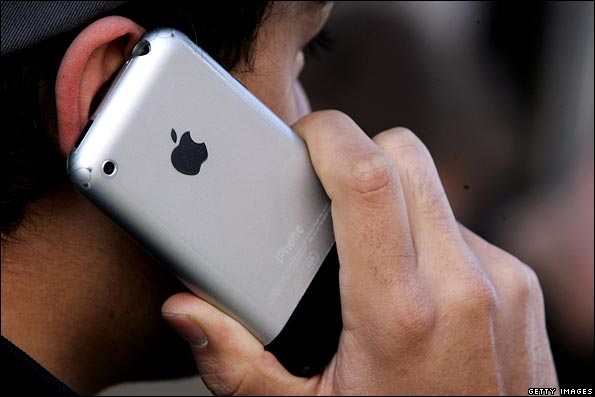
My answer? Well at least one of those networks has told me the rumours are untrue, but it seems likely that Apple is testing the waters with companies other than O2 before making its mind up about whether it wants to renew that exclusive contract.
And as for the last question, the issue is obviously of limited concern if you're not a potential customer - but it appears to be causing a frenzy of excitement amongst the different networks jostling for a deal.
And I've just met a man who was interested, not so much in the iPhone or who will sell it in the UK, but in the whole question of how mobile operators are handling the huge amount of data that phones like this are sending across their networks, a subject we covered recently here.
Michael Schabel is director of research at Bell Labs, the birthplace of some of the more important inventions of the 20th Century, and now under the ownership of Alcatel Lucent.
He was in town to push a product his company sells to mobile networks to help them manage congestion, but when I met him over breakfast he was marvelling at the complete transformation of the mobile web over the last 18 months.
Two things have happened - first, networks started pushing mobile broadband, then Apple invented the mobile app. (Yes, I know there were apps before the app store, but it was the iPhone that made them insanely popular.)
Mr Schabel told me the average iPhone user has downloaded 27 applications - "that's probably more than they have on their PC".
And of course that's been followed by other manufacturers. Michael Schabel showed me the Pandora application on his Blackberry, allowing him to listen to the streaming music radio service on the road, and told me there was no reason why we shouldn't all be streaming music and video to our phones fairly easily quite soon.
But that all adds up, according to Mr Schabel, to a "tsunami of data" and a radical change in the mobile landscape, and the operators are finding it difficult to cope.
Handling the bits and bytes flying around from all of this new mobile activity involves different skills from dealing with voice calls or from those needed to control internet traffic across a fixed line network.
Users of mobile networks can suddenly find they just can't get online - or use a particular application and yet to the operator everything on the network looks fine.
That, according to a research paper from Alcatel Lucent, is because the type of traffic can vary radically from one 3G cell to another. In one area a cell can be choked by streaming media, while its neighbour will suddenly be occupied by peer-to-peer traffic, perhaps involving people using mobile dongles.
And while a fixed line broadband supplier might simply opt to throttle back streaming video across its network, that's not going to have the desired effect on a cellular network.
To mobile customers, of course, the technology and the challenges faced by the operators are of no interest. They are now getting used to checking the cricket score, updating their social network status or playing an online game via their mobile phones. And if they find they can't, they will get rather cross.
Which brings us back to where we started. I'm sure Apple will indeed be looking at doing deals with other operators besides O2 - but it will want to be sure their networks are ready to handle that growing flood of data from all those billions of apps.
The BBC is not responsible for the content of external internet sites
This is dot.life - a blog about technology from BBC News.
Rory Cellan-Jones is the BBC's technology correspondent.
Maggie Shiels is the BBC's tech reporter based in Silicon Valley.
Archive
« January 2010
| Sun | Mon | Tue | Wed | Thu | Fri | Sat |
|---|---|---|---|---|---|---|
| 1 | 2 | |||||
| 3 | 4 | 5 | 6 | 7 | 8 | 9 |
| 10 | 11 | 12 | 13 | 14 | 15 | 16 |
| 17 | 18 | 19 | 20 | 21 | 22 | 23 |
| 24 | 25 | 26 | 27 | 28 |
Being Discussed Now
- Logging out... and straight back in(3)
- Gadgets of the Noughties(20)
- Plastic Logic's long journey to Vegas(21)
- Sexting teens(17)
- Wikipedia on the wane?(49)
- 'Cooling-off' for mobile phones? Not on the High Street(37)
- 2009 - the social year(36)
- Twitter, Iran and #uksnow(25)
- Broadband Britain - how far down the league?(55)
- Microsoft and Murdoch: Teaming up to bash Google?(34)
BBC Technology Headlines
- %28none%29
%28none%29 - %28none%29
%28none%29 - %28none%29
%28none%29
Visit the Technology index
Visit the BBC News website
Rory's TV/Radio reports
- Residents block Google car
Broadcast: 3 April 2009 - New adverts to tackle film piracy
Broadcast: 2 April 2009 - Call to scrap 'illegal databases'
Broadcast: 23 March 2009 - Female robot takes to the catwalk
Broadcast: 16 March 2009 - Super-charged battery breakthrough
Broadcast: 12 March 2009

- News Editors
- Sport Editors
- Journalism Labs
- BBC Internet Blog
- Radio 4 Blog
- Peston's Picks
- Nick Robinson's Newslog
- Stephanomics
- Mark Easton's UK
- Mark Mardell's America
- Nick Bryant's Australia
- Andrew Harding on Africa
- Gavin Hewitt's Europe
- Soutik Biswas' India
- dot.Rory
- Science: Jonathan Amos
- Richard Black on environment
- Today: Tom Feilden
- Fergus Walsh's medical files
- Newsnight: Paul Mason
- Newsnight: Mark Urban
- Torin Douglas
- Will Gompertz's arts
- Phil Coomes on photojournalism
- Magazine Monitor
- Mark D'Arcy in Westminster
- NI: Mark Devenport
- Scotland: Brian Taylor
- Scotland: Douglas Fraser
- Wales: Betsan Powys
- Martin Rosenbaum on FOI
- 5 Live Breakfast
- Newsnight
- PM programme (iPM)
- World Tonight: Robin Lustig
