


Can O2 cope with smartphone traffic?
- 7 Jul 09, 14:40 GMT
It's been announced today that O2 has won the exclusive contract to sell the new Palm Pre in Britain.
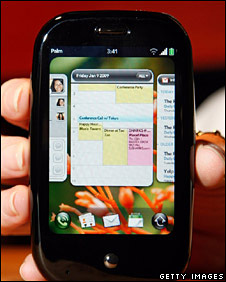 That means it will be the only UK network selling what many regard as the two smartest phones on the market right now, the Pre and Apple's iPhone.
So congratulations to O2 - but just a little question. Is your network really good enough to cope with the flood of data?
Because the whole point of both phones is that users will be doing far more than just talking and texting - they will be online all of the time making the most of their unlimited data packages built into the pricey contracts you will be selling them.
iPhone users have already shown a far greater appetite for data than owners of just about any other phone - surfing the web more, uploading far more pictures to Flickr, and of course using all those online apps they've installed on their phones.
And the advent of the iPhone 3Gs has only accelerated that trend, with Google reporting that uploads to YouTube from a mobile soared by 400% in the days after the launch of the first video-capable iPhone.
But if my experience is anything to go by, users of either of these phones may hit heavy traffic on the web as they try to surf, download and share information and pictures online.
O2 tells me that users on its 3G data network experience speeds "up to 3.6Mbps" and says it has begun rollout of "up to 7.2Mbps". The company says it has good coverage across most of the UK, with built-up areas obviously doing better.
I've been testing those claims using a handy little application called Speed Test - which does what it says on the tin. Over the past month I've done a series of tests on an iPhone, all of them in the London area, where you'd expect to get a pretty good signal.
I did once get a download speed of 1.7Mbps, but in most cases the speeds were below 1Mbps, and quite frequently, the 3G network just didn't appear to be there at all.
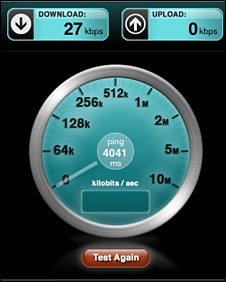 The picture on the right shows a test conducted by the window of my office in West London - as you can see, the phone is apparently downloading at just 27Kbps and uploading at....well, 0.
If I'd wanted to send some video to YouTube, I would have had a long and fruitless wait - and the phone's battery would have given out long before I'd uploaded.
Mobile reception in or near buildings can be problematic, but on my morning walk with the dog near my home, I've noticed that the 3G network evaporates altogether when I get to the park.
I called 02, and the company confirmed that there was a small hole in the network in the place I described. The firm said it really needed to upgrade a nearby phone mast - but was wary of the reaction from residents who'd protested before about 3G masts.
I do feel some sympathy for phone networks, besieged on the one hand by geeks like me demanding better service - and on the other by campaigners fearful that phone masts could in some way pose a danger to health. And O2 is no different from the other networks in making somewhat fanciful claims about the speeds that can be achieved by mobile broadband customers.
But if mobile networks are going to become one of the key routes to the internet for million of users, they're going to need to build more six-lane highways to replace those B-roads where the traffic keeps getting stuck.
Update, 10:43, 8 July: This morning Ofcom has published a report on the state of 3G coverage in the UK, and the growing importance of mobile broadband to consumers.
It includes maps of each network's 3G coverage [668KB PDF]. And it has to be said that O2's coverage looks pretty thin compared to other networks, with 3 in particular looking as though it reaches far more places across the UK.
The audio revolution gathers pace
- 7 Jul 09, 08:43 GMT
A few months ago, I wrote here about what I saw as an audio revolution on the web, with a new service called AudioBoo allowing internet users to share sounds and speech in the way the likes of YouTube help them to share video.
Now this revolution is gathering pace. As I've reported on this morning's Radio 4 Today programme, AudioBoo is attracting more and more content - celebrities like Stephen Fry are "booing", evangelists are using it for daily sermons, chefs and photographers are using it to broadcast daily tips, and citizen journalists have been sending audio reports from events like the G20 protests.
In order to see this content you need to have both Javascript enabled and Flash installed. Visit BBC Webwise for full instructions. If you're reading via RSS, you'll need to visit the blog to access this content.
I particularly enjoyed this offering recorded by the Radio 4 newsreader Neil Sleat as he prepared for an afternoon bulletin. Having started as just an application for the iPhone, AudioBoo is now moving on to other phones, and has ambitious plans to expand further.
And there's now competition in the form of a rival service called ipadio. Unlike AudioBoo, you don't need wi-fi or even a 3G connection to use this way of sharing audio.
Ipadio's idea is to allow any phone user to broadcast live to the internet by simply making a call to the service. That means you only get phone quality audio - unlike the higher quality recordings you can make and upload using AudioBoo.
But Ipadio says it is "a live streaming phone reporting tool" whereas AudioBoo is a "record and publish" tool - and the company believes there is room for both.
Among those who've recorded "phlogs", as the company calls them are the Mayor of London Boris Johnson, the Paralympic champion Dame Tanni Grey-Thompson, and a doctor recording an audio diary of his walk across the Pyrenees to raise money for a kidney charity.
 The BBC's World Service has started an interesting project using some of these new audio tools. It's called Save Our Sounds, and the aim is to gather sounds from around the world which might otherwise be lost.
We're asking listeners to the Today programme to take part in this exercise, by recording audio from around Britain and uploading it to the Save Our Sounds site. If you could use the tag #r4today, that would help us to identify recordings made by listeners to the programme.
So, forget video - the future is sounds, not pictures - and you can be part of it. Or at least that's what my radio colleagues tell me.
The BBC is not responsible for the content of external internet sites
This is dot.life - a blog about technology from BBC News.
Rory Cellan-Jones is the BBC's technology correspondent.
Maggie Shiels is the BBC's tech reporter based in Silicon Valley.
Archive
« January 2010
| Sun | Mon | Tue | Wed | Thu | Fri | Sat |
|---|---|---|---|---|---|---|
| 1 | 2 | |||||
| 3 | 4 | 5 | 6 | 7 | 8 | 9 |
| 10 | 11 | 12 | 13 | 14 | 15 | 16 |
| 17 | 18 | 19 | 20 | 21 | 22 | 23 |
| 24 | 25 | 26 | 27 | 28 |
Being Discussed Now
- Logging out... and straight back in(3)
- Gadgets of the Noughties(20)
- Plastic Logic's long journey to Vegas(21)
- Sexting teens(17)
- Wikipedia on the wane?(49)
- 'Cooling-off' for mobile phones? Not on the High Street(37)
- 2009 - the social year(36)
- Twitter, Iran and #uksnow(25)
- Broadband Britain - how far down the league?(55)
- Microsoft and Murdoch: Teaming up to bash Google?(34)
BBC Technology Headlines
- %28none%29
%28none%29 - %28none%29
%28none%29 - %28none%29
%28none%29
Visit the Technology index
Visit the BBC News website
Rory's TV/Radio reports
- Residents block Google car
Broadcast: 3 April 2009 - New adverts to tackle film piracy
Broadcast: 2 April 2009 - Call to scrap 'illegal databases'
Broadcast: 23 March 2009 - Female robot takes to the catwalk
Broadcast: 16 March 2009 - Super-charged battery breakthrough
Broadcast: 12 March 2009

- News Editors
- Sport Editors
- Journalism Labs
- BBC Internet Blog
- Radio 4 Blog
- Peston's Picks
- Nick Robinson's Newslog
- Stephanomics
- Mark Easton's UK
- Mark Mardell's America
- Nick Bryant's Australia
- Andrew Harding on Africa
- Gavin Hewitt's Europe
- Soutik Biswas' India
- dot.Rory
- Science: Jonathan Amos
- Richard Black on environment
- Today: Tom Feilden
- Fergus Walsh's medical files
- Newsnight: Paul Mason
- Newsnight: Mark Urban
- Torin Douglas
- Will Gompertz's arts
- Phil Coomes on photojournalism
- Magazine Monitor
- Mark D'Arcy in Westminster
- NI: Mark Devenport
- Scotland: Brian Taylor
- Scotland: Douglas Fraser
- Wales: Betsan Powys
- Martin Rosenbaum on FOI
- 5 Live Breakfast
- Newsnight
- PM programme (iPM)
- World Tonight: Robin Lustig
