


Is the web's amateur hour over?
- 5 Jun 09, 09:48 GMT
The Antichrist of Silicon Valley has been in London this week.
At least, that's the title that Andrew Keen, a strident critic of web utopianism, revels in. Mr Keen is a British-born entrepreneur who made his fortune in Silicon Valley and then decided, with all the zeal of a reformed smoker or lapsed Catholic, that everything the web 2.0 evangelists stood for was evil. What really gets his goat is the idea that the web liberates everyone to become a journalist, film-maker, musician - or encyclopedia author - thereby devaluing the work of professionals.
His book The Cult Of The Amateur is an enjoyable rant against web orthodoxy which sometimes descends into bathos as he describes how seasoned professionals are being put out of work by amateurs with a YouTube account or a penchant for editing Wikipedia entries. It would take a heart of stone, for instance, not to weep for the advertising professionals whose careers he sees threatened by kids making viral ads with a handycam and sticking them on YouTube.
At a dinner in London, Andrew Keen challenged an assembly of web worthies - entrepreneurs, thinkers, even a few grubby technology journalists - to explain why they were so enamoured of the amateurs. Why, he wanted to know, was there such reverence for the citizen journalists and bloggers and musicians who were eating our lunch? He seemed particularly offended by Wikipedia, expressing incredulity at the idea that the whole project depended on people who worked for nothing.
But whether or not you agree with Mr Keen's analysis that "Web 2.0" is a threat to our culture, his analysis is now beginning to look a little dated. Amateur hour on the web may be drawing to a close. True, new technology is lowering the barrier to entry in all sorts of professions. In my own business, journalism, it's never been easier or cheaper to write, record and film reports for the world to share.
I was asked this week by the BBC's School Report website to give my top ten tips for aspiring young technology journalists, and was keen to stress that it was very easy these days for anyone to get involved without first being part of a mainstream media organisation.
But what is now becoming clear is that it's much harder for amateurs to get an audience. Who, for instance, are the most successful bloggers? Well, many of them are actually old-fashioned professional journalists working for mainstream media organisations which pay them to blog.
 And whatever we were told a couple of years back about unsigned bands making it big on MySpace and new film-makers breaking into the big time on YouTube, I've yet to spot the new band or movie which has made a major impact without the help of a record label or a studio. The professionals have woken up to the power of Web 2.0 - and are moving in to colonise it.
There was a long discussion at the dinner with Andrew Keen about the difference between an amateur and a professional, but to me it seems pretty obvious - professionals get paid, amateurs do it for love.
That's not to say that people in all walks of life - writers, musicians, politicians, perhaps even bankers - don't start off driven by creative or idealistic passions rather than by the need to make a living. But many of the amateurs will either fade away, discouraged by their failure to command an audience, or will turn professional.
Certainly, many of the Web 2.0 companies - from Facebook to YouTube to Twitter - seemingly started off with hardly a thought as to how they might profit from their activities. Now harsh economic times are forcing them to look down at the bottom line rather than up at the stars.
Andrew Keen may be right that we have an excessively romantic view of the amateur. But he shouldn't worry too much. His success is proof that there is still a good living to be made as a professional writer and provocateur.

Cue some iPhone fever
- 5 Jun 09, 09:34 GMT
Yes, dear readers, it's that time of year again: rumours abound about what Apple will or will not do as Monday's World Wide Developers Conference in San Francisco approaches.
As usual, the company is tight-lipped - which, as always, just adds to the frenzy. That, of course, is the way they like it and the way we always play it. At least we all have our roles down pat!
Unsurprisingly, this year's rumours centre on the iPhone, which has sold around 21 million handsets in its roughly two-and-a-half short years.
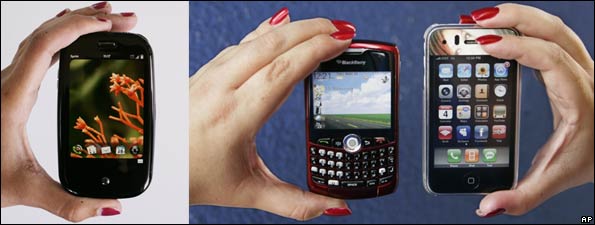
One analyst, Gartner, reports that the iPhone was the fastest-growing smartphone of 2008; another, PiperJaffray, believes that Apple can grow its sales to 45 million units by the end of 2009.
Let's not forget that it still ranks third behind Nokia and Research in Motion's BlackBerry. And let's throw in the unknown factor of the Palm Pre, which launches in the States this weekend and which some industry watchers have touted as a serious challenger to Apple.
Rumoured iPhone features include better battery life, a video camera, memory upgrades, a speedier processor and a digital compass. There has also been talk of a cheaper handset, selling at around $99-$149.
The previously-announced improvements to the operating system via a software upgrade should be rolled out, adding in-app commerce, live streaming and the ability to cut and paste. There will also be some new numbers on the app store - which, earlier in the year, passed the one billion download mark. But does all this really set the heather on fire?
Well, it would if "you know who" were doing the honours from centre stage. Apple's founder and CEO Steve Jobs has been on sick leave since the beginning of the year and is due back at his desk at the end of the month.
Naturally, the "will he / won't he" question of Mr Jobs making an appearance at the WWDC comes down to a fact that nobody really knows, except for the chosen few and his nibs.
The BBC will be there to report on whether or not the rumour mill got it right this time and whether Apple pulls out its famous "one last thing" to wow the crowd.
The BBC is not responsible for the content of external internet sites
This is dot.life - a blog about technology from BBC News.
Rory Cellan-Jones is the BBC's technology correspondent.
Maggie Shiels is the BBC's tech reporter based in Silicon Valley.
Archive
« January 2010
| Sun | Mon | Tue | Wed | Thu | Fri | Sat |
|---|---|---|---|---|---|---|
| 1 | 2 | |||||
| 3 | 4 | 5 | 6 | 7 | 8 | 9 |
| 10 | 11 | 12 | 13 | 14 | 15 | 16 |
| 17 | 18 | 19 | 20 | 21 | 22 | 23 |
| 24 | 25 | 26 | 27 | 28 |
Being Discussed Now
- Logging out... and straight back in(3)
- Gadgets of the Noughties(20)
- Plastic Logic's long journey to Vegas(21)
- Sexting teens(17)
- Wikipedia on the wane?(49)
- 'Cooling-off' for mobile phones? Not on the High Street(37)
- 2009 - the social year(36)
- Twitter, Iran and #uksnow(25)
- Broadband Britain - how far down the league?(55)
- Microsoft and Murdoch: Teaming up to bash Google?(34)
BBC Technology Headlines
- %28none%29
%28none%29 - %28none%29
%28none%29 - %28none%29
%28none%29
Visit the Technology index
Visit the BBC News website
Rory's TV/Radio reports
- Residents block Google car
Broadcast: 3 April 2009 - New adverts to tackle film piracy
Broadcast: 2 April 2009 - Call to scrap 'illegal databases'
Broadcast: 23 March 2009 - Female robot takes to the catwalk
Broadcast: 16 March 2009 - Super-charged battery breakthrough
Broadcast: 12 March 2009

- News Editors
- Sport Editors
- Journalism Labs
- BBC Internet Blog
- Radio 4 Blog
- Peston's Picks
- Nick Robinson's Newslog
- Stephanomics
- Mark Easton's UK
- Mark Mardell's America
- Nick Bryant's Australia
- Andrew Harding on Africa
- Gavin Hewitt's Europe
- Soutik Biswas' India
- dot.Rory
- Science: Jonathan Amos
- Richard Black on environment
- Today: Tom Feilden
- Fergus Walsh's medical files
- Newsnight: Paul Mason
- Newsnight: Mark Urban
- Torin Douglas
- Will Gompertz's arts
- Phil Coomes on photojournalism
- Magazine Monitor
- Mark D'Arcy in Westminster
- NI: Mark Devenport
- Scotland: Brian Taylor
- Scotland: Douglas Fraser
- Wales: Betsan Powys
- Martin Rosenbaum on FOI
- 5 Live Breakfast
- Newsnight
- PM programme (iPM)
- World Tonight: Robin Lustig
