


Life in the slow lane
- 27 May 09, 09:44 GMT
Remember when it took five minutes to load a web page - and when every minute on the web meant no incoming phone calls? It's diifficult to recall how we used to live without broadband - until that is, you meet a family like the Shaws. They live just outside the village of Warcup in Cumbria - so far down the line from the nearest BT exchange that the most they can hope for is a dial-up connection.
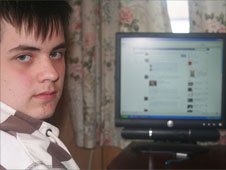 We filmed David Shaw, as he waited for what seemed an age just for Google to load. Then he cut the connection - so that we could go next door and watch his 14-year-old son John try to get onto Facebook. That took about five minutes, and John explained that he hardly bothered to upload photographs, like his friends, because it was just not worth the wait.
Caroline Shaw told us that it was particularly hard, as they'd moved from a home which did have broadband just as it was becoming ever more vital for the children to use the internet in their school work. "They've got to stay at school to do their homework, which means they miss the school bus - so we have to go six miles to pick them up."
From Warcup, we headed to an equally remote home perched on the side of a hill a few miles outside Alston. But Jules Cadie, an artist and web designer, was very happy with his internet connection, from the Cybermoor Community network. In the 300-year-old converted cowshed which is his office, Jules explained to me that he couldn't have lived here if there was no broadband. "I just couldn't compete with people in urban areas without it."
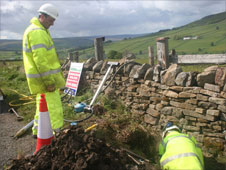 It's thanks to the passion and commitment of people like Daniel Heery, who runs the Cybermoor network, that areas like this are not being left on the wrong side of a digital divide. He took me to see the future, the fibre being laid on rural roads to give Cybermoor much faster connections. It looks a costly business - holes were being dug either side of a farm gate, so that a pipe could be inserted and fibre blown along it. A lot of work, just to bring a few scattered homes within range of a network that will deliver 20Mbps at first, and more later.
You can't see this kind of network ever being a commercial proposition - Cybermoor gets by on a ragbag of contributions from the NHS, the schools budget, and subscription income. Most of the work to bring next generation broadband to Britain will have to be done by the likes of BT and Virgin Media. But this kind of community effort may provide at least part of the answer to filling the holes in their networks.
We've been using the Cybermoor network this morning to send live television pictures from Alston to London and around the world. Meanwhile, a few miles away, the Shaws are just hoping they can soon get any kind of broadband connection - so that John can put a few pictures on Facebook.

Return of the Zune?
- 27 May 09, 06:04 GMT
The Zune is back - well, sort of.
Microsoft has announced that the Zune will now morph into an entertainment platform - across PC, mobile and console - including HD TV and film content on the Xbox Live service in Europe.
No details of what that content is yet, however, nor how it will integrate, if at all, with an announcement in the UK on Thursday expected to involve a major TV partner
Microsoft also announced a new HD Zune player, with built-in HD radio. And guess what? It's only available in the US - again.
While it's impossible to draw judgement on the first part of the announcement, the launch of a new device once again in the US only must mark the last throw of the dice for Microsoft in the portable player market.
Can Zune ever rise above its place in popular culture as a by-word for coming in second?
More details here.
The BBC is not responsible for the content of external internet sites
This is dot.life - a blog about technology from BBC News.
Rory Cellan-Jones is the BBC's technology correspondent.
Maggie Shiels is the BBC's tech reporter based in Silicon Valley.
Archive
« January 2010
| Sun | Mon | Tue | Wed | Thu | Fri | Sat |
|---|---|---|---|---|---|---|
| 1 | 2 | |||||
| 3 | 4 | 5 | 6 | 7 | 8 | 9 |
| 10 | 11 | 12 | 13 | 14 | 15 | 16 |
| 17 | 18 | 19 | 20 | 21 | 22 | 23 |
| 24 | 25 | 26 | 27 | 28 |
Being Discussed Now
- Logging out... and straight back in(3)
- Gadgets of the Noughties(20)
- Plastic Logic's long journey to Vegas(21)
- Sexting teens(17)
- Wikipedia on the wane?(49)
- 'Cooling-off' for mobile phones? Not on the High Street(37)
- 2009 - the social year(36)
- Twitter, Iran and #uksnow(25)
- Broadband Britain - how far down the league?(55)
- Microsoft and Murdoch: Teaming up to bash Google?(34)
BBC Technology Headlines
- %28none%29
%28none%29 - %28none%29
%28none%29 - %28none%29
%28none%29
Visit the Technology index
Visit the BBC News website
Rory's TV/Radio reports
- Residents block Google car
Broadcast: 3 April 2009 - New adverts to tackle film piracy
Broadcast: 2 April 2009 - Call to scrap 'illegal databases'
Broadcast: 23 March 2009 - Female robot takes to the catwalk
Broadcast: 16 March 2009 - Super-charged battery breakthrough
Broadcast: 12 March 2009

- News Editors
- Sport Editors
- Journalism Labs
- BBC Internet Blog
- Radio 4 Blog
- Peston's Picks
- Nick Robinson's Newslog
- Stephanomics
- Mark Easton's UK
- Mark Mardell's America
- Nick Bryant's Australia
- Andrew Harding on Africa
- Gavin Hewitt's Europe
- Soutik Biswas' India
- dot.Rory
- Science: Jonathan Amos
- Richard Black on environment
- Today: Tom Feilden
- Fergus Walsh's medical files
- Newsnight: Paul Mason
- Newsnight: Mark Urban
- Torin Douglas
- Will Gompertz's arts
- Phil Coomes on photojournalism
- Magazine Monitor
- Mark D'Arcy in Westminster
- NI: Mark Devenport
- Scotland: Brian Taylor
- Scotland: Douglas Fraser
- Wales: Betsan Powys
- Martin Rosenbaum on FOI
- 5 Live Breakfast
- Newsnight
- PM programme (iPM)
- World Tonight: Robin Lustig
