


Turning tech into telly...
- 19 May 09, 10:45 GMT
You will often hear these days that television news ain't what it used to be, that there was a golden age, say 20 years ago, when it was a much more intelligent and useful medium - and of course far more people watched it.
Well, as someone who's been in the TV news trade for more than two decades, I just don't believe it. Yes, the audiences have declined but the standard of the product is much improved.
I've had occasion recently to haul out of the archive some old TV news pieces to show to journalism students. They were, quite frankly, lame - as the students themselves pointed out.
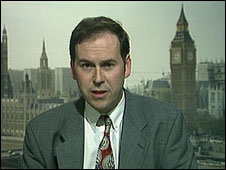 One in particular, about a major economic crisis of the early 90s, was hopeless in telling a complex but important story. It consisted of long swathes of what's known in the trade as wallpaper - meaningless shots of Westminster and ministerial cars driving past - covered with commentary and interspersed with clips of politicians.
Economics was a subject I used to cover, and I must admit that many of my reports were as bad, or worse, than what I showed the students. Economics and business stories have always been a challenge to turn into television.
I have at times told one of our senior editors who trains newcomers to the newsroom that he needs to tell them less about using pictures to describe wars, earthquakes and other dramatic events and more about how you turn the demise of the final salary pension scheme into a compelling TV news report.
Anyway, all that is a preamble for some thoughts on my current preoccupation - turning technology into television, which is, believe it or not, almost as big a challenge.
Mobile phones, computer screens and endless shots of websites make for very dull pictures - and then you have the problem of getting techie people to talk in terms that will mean something to a mass audience.
But the advantage I have today is that while I may not have moved on that far, the creative people I work with - producers, camera operators and picture editors - certainly have.
What's more, the advance in broadcasting technology - from computer graphics, to digital editing, to new means of reaching people via the internet - have made it possible to approach complex subjects and visualise them in new way.
So here's an example.
In order to see this content you need to have both Javascript enabled and Flash installed. Visit BBC Webwise for full instructions. If you're reading via RSS, you'll need to visit the blog to access this content.
Last week I decided to try to sell a story to the TV news bulletins on the future of web search, linked to the upcoming launch of the Wolfram Alpha "computational knowledge engine". This was obviously going to be extremely hard to sell to editors during a busy news period, and hard to film.
I wanted both Wolfram and Google in the piece, and while both are fascinating subjects, each is, in picture terms, very dull.
Then there was arranging an interview with the main protagonist, Stephen Wolfram. He was in Illinois, and I didn't think our World News department would think it was worth the cost of sending a crew there.
Instead, after long discussions with Wolfram's PR people, we arranged to chat with him over the internet, which gave us some pictures as we filmed the call from our end. The problem with an internet video call is always the quality - of the audio more than the video.
But Wolfram Research agreed to record the interview at their end, and then send it to me, as a 30-minute 1.8Gb file. Luckily, I was working with Doug Dalgleish, a cameraman who is also a technical whizz, and he managed to make everything work.
Stephen Wolfram is a brilliant and enthusiastic evangelist for his vision of the future of search - but getting a 15-second clip from our interview to use in a two-minute TV news piece was a bit of a struggle. (We did make more of the interview available on the web).
Google was somewhat easier - we were able to go along to their funky London offices and interview a senior executive Mario Queiroz about where search was heading. Still desperate for pictures, we shot a sequence of him using the new Google Squared product and me using Wolfram Alpha to answer the same queries.
In the Google lobby the most popular search terms currently being entered by its global users are projected onto a wall - so that made a nifty location for my piece to camera, linking between the two sections of the report.
But when on Monday we came to edit the piece, we were still faced with a desperate dearth of interesting pictures. Riding to the rescue came Nick Tulip, our picture editor.
Cutting film and later video together has always been a skilful activity, but the arrival of digital editing, allowing all sorts of effects, has transformed the craft and Nick is among the very best and most inventive of the new breed.
I decided that we should illustrate the type of question that Google found hard to answer - how far is the earth from the sun at this moment, how is the population of India growing compared with that of China, how far is it from London to Glasgow? Nick pulled some pictures out of our digital archive, and superimposed a Google search box image over them. He then set about making two rather dull websites somehow look interesting, with the aid of some of Doug's imaginative shots of the Google offices.
The result was by no means a masterpiece and, like all TV news reports, could only scratch at the surface of a complex subject but Nick, Doug and I were all pretty satisfied with our work. But here's the irony. Monday was a very busy news day in the UK with all sorts of stories - the Speaker row, the conflict in Sri Lanka , England's World Cup bid - and our report did not make it onto the domestic news bulletins, though it was shown on BBC World.
So, in my view, we are now able to tell complicated stories much more effectively on television. But, in a busy world, where politics, business and sport are vying for viewers' attention, getting them broadcast is another matter.
Luckily we now have something that was not available to TV journalists two decades ago, the web, so even something that doesn't make it to air can find a lasting home online.
The BBC is not responsible for the content of external internet sites
This is dot.life - a blog about technology from BBC News.
Rory Cellan-Jones is the BBC's technology correspondent.
Maggie Shiels is the BBC's tech reporter based in Silicon Valley.
Archive
« January 2010
| Sun | Mon | Tue | Wed | Thu | Fri | Sat |
|---|---|---|---|---|---|---|
| 1 | 2 | |||||
| 3 | 4 | 5 | 6 | 7 | 8 | 9 |
| 10 | 11 | 12 | 13 | 14 | 15 | 16 |
| 17 | 18 | 19 | 20 | 21 | 22 | 23 |
| 24 | 25 | 26 | 27 | 28 |
Being Discussed Now
- Logging out... and straight back in(3)
- Gadgets of the Noughties(20)
- Plastic Logic's long journey to Vegas(21)
- Sexting teens(17)
- Wikipedia on the wane?(49)
- 'Cooling-off' for mobile phones? Not on the High Street(37)
- 2009 - the social year(36)
- Twitter, Iran and #uksnow(25)
- Broadband Britain - how far down the league?(55)
- Microsoft and Murdoch: Teaming up to bash Google?(34)
BBC Technology Headlines
- %28none%29
%28none%29 - %28none%29
%28none%29 - %28none%29
%28none%29
Visit the Technology index
Visit the BBC News website
Rory's TV/Radio reports
- Residents block Google car
Broadcast: 3 April 2009 - New adverts to tackle film piracy
Broadcast: 2 April 2009 - Call to scrap 'illegal databases'
Broadcast: 23 March 2009 - Female robot takes to the catwalk
Broadcast: 16 March 2009 - Super-charged battery breakthrough
Broadcast: 12 March 2009

- News Editors
- Sport Editors
- Journalism Labs
- BBC Internet Blog
- Radio 4 Blog
- Peston's Picks
- Nick Robinson's Newslog
- Stephanomics
- Mark Easton's UK
- Mark Mardell's America
- Nick Bryant's Australia
- Andrew Harding on Africa
- Gavin Hewitt's Europe
- Soutik Biswas' India
- dot.Rory
- Science: Jonathan Amos
- Richard Black on environment
- Today: Tom Feilden
- Fergus Walsh's medical files
- Newsnight: Paul Mason
- Newsnight: Mark Urban
- Torin Douglas
- Will Gompertz's arts
- Phil Coomes on photojournalism
- Magazine Monitor
- Mark D'Arcy in Westminster
- NI: Mark Devenport
- Scotland: Brian Taylor
- Scotland: Douglas Fraser
- Wales: Betsan Powys
- Martin Rosenbaum on FOI
- 5 Live Breakfast
- Newsnight
- PM programme (iPM)
- World Tonight: Robin Lustig
