


Web video - who can make it pay?
- 28 Apr 09, 15:36 GMT
What's the most powerful force on the web right now? No, not Twitter - still a minority interest - but video, in all its forms.
In the last couple of weeks we've seen three examples of the popularity and importance of moving pictures on the internet. But each of them raises a few more questions about the economics of web video.
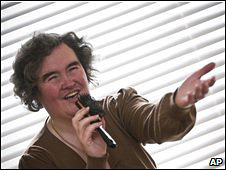 When Susan Boyle first appeared on Britain's Got Talent, 11 million people watched her on ITV. But within a day or so, far more had viewed her on YouTube, and a fortnight on, her various clips online have given the 48-year-old singing sensation a bigger audience than even Barack Obama achieved.
So has that produced a windfall for ITV, which could certainly do with a boost to advertising revenues right now?
As well as looking at YouTube, viewers could also go to itv.com for clips from the programme and it has certainly seen a big boost in its traffic.
But on YouTube, there is no advertising to be seen near the Britain's Got Talent clips, and there's not much on itv.com. Even if there were, each online ad viewer would be worth a fraction of anyone catching commercial breaks on the television.
For another media outlet, a different kind of web video hit. The Guardian's footage of the moment Ian Tomlinson was pushed to the ground by police at the G20 protest - or rather the video acquired from a member of the public - was a major scoop.
But did it do much for the sales of the newspaper? I doubt it, because most people will have seen the video - either on the Guardian website or more likely on television news broadcast the night before.
The pictures will have driven plenty of traffic to the Guardian's site - but again, the advertising rates there will not match what is achieved in the newspaper. Video content on newspaper websites is becoming more and more important, but is still struggling to find a business model.
One online video service which doesn't need to make money, of course, is the BBC iPlayer. Last week it went HD, making it an even more attractive alternative to live television.
But an HD iPlayer is also more expensive - for the BBC (how much, I'm told, is commercially sensitive), for some viewers who may have to buy extra bandwidth from their internet service providers, and for those ISPs, who've already complained about the strain the standard definition version places on the network.
Still, the iPlayer - along with the online services from ITV, Channel 4 and Sky - is proving why we might need to build a faster broadband network across the UK, as more and more television viewing migrates onto the internet. So that leaves us with only two simple questions to answer.
Who will pay to bring that HD-capable broadband network to every home - because, as we know, BT and Virgin Media only plan to cover half the UK with super-fast broadband - and who can work out how to make money by pumping video along it?
Update: Many thanks to Shravan Nagraj in the comments for pointing out that our friends at the BBC Internet Blog are hosting a conversation about how these issues relate to BBC iPlayer in their Open Post.

Phorm hoping to stop 'phoul play'
- 28 Apr 09, 15:15 GMT
From the moment Phorm first hit the headlines in 2008, controversy has dogged the online advert targeting firm.
 Its history as a technology company accused of peddling spyware immediately antagonised privacy campaigners.
And when it was revealed that Phorm and BT had carried out secret trials of the technology, which monitors users' web habits without their consent, battle lines were drawn.
At the heart of the argument is a debate over whether Phorm's technology breaks UK data interception laws. The European Commission has also waded into the issue, asking for better protection for consumers.
This has been a battle fought on message boards and forums, in detailed technical assessments of the technology, and even within government.
Phorm asserts that it is doing nothing wrong, that it sets higher standards of privacy and protection than rivals and that it has the support of bodies like the Information Commissioners' Office, the Home Office and the Department for Business, Enterprise & Regulatory Reform.
However, anti-Phorm campaigners have gone to each of these bodies and in turn received word that they have not endorsed Phorm's technology.
Indeed, the Home Office says it has never advised Phorm that its technology does not break UK law.
Yet e-mails between the Home Office and Phorm released under Freedom of Information appear to show the Home Office doing precisely that, and also asking Phorm for comments and changes to a document it was drawing up in order to ascertain the company's legal status.
At one point, a Home Office official asks whether Phorm and its clients will be "comforted" by the document.
Of course, the Home Office will regularly consult with private enterprise when it draws up informal guidance, especially around new technologies.
Lord West of Spithead, the government's Under-Secretary of State at the Home Office, explained to the House of Lords last year why the government had met with Phorm:
"This was an informal meeting to improve officials' understanding of the ways in which targeted online advertising could be undertaken. There was no agenda and no minutes were taken."
He added: "It would not be appropriate to provide details of that communication to a legal adviser in Phorm as we believe it is subject to legal privilege."
But anti-Phorm campaigners are questioning why the Home Office and Phorm were exchanging the document in question.
Phorm believes it is being unfairly singled out: it also believes it is the victim of an orchestrated "smear" campaign:
"Over the last year Phorm has been the subject of a smear campaign orchestrated by a small but dedicated band of online 'privacy pirates' who appear very determined to harm our company."
It has set up a website to counter these smears, called Stop Phoul Play.
The site also hints that this campaign may be the work of Phorm's competitors:
"Their energetic blogging and letter-writing campaigns, targeted at journalists, MPs, EU officials and regulators, distort the truth and misrepresent Phorm's technology."We have decided to expose the smears and set out the true story, so that you can judge the facts for yourself."
The company has also accused one of the leading campaigners of being a "serial agitator".
This is a battle with no sign of a ceasefire, with both sides settling down to a war of attrition, and with governments, both in the UK and the EU, drawn into the crossfire.
The BBC is not responsible for the content of external internet sites
This is dot.life - a blog about technology from BBC News.
Rory Cellan-Jones is the BBC's technology correspondent.
Maggie Shiels is the BBC's tech reporter based in Silicon Valley.
Archive
« January 2010
| Sun | Mon | Tue | Wed | Thu | Fri | Sat |
|---|---|---|---|---|---|---|
| 1 | 2 | |||||
| 3 | 4 | 5 | 6 | 7 | 8 | 9 |
| 10 | 11 | 12 | 13 | 14 | 15 | 16 |
| 17 | 18 | 19 | 20 | 21 | 22 | 23 |
| 24 | 25 | 26 | 27 | 28 |
Being Discussed Now
- Logging out... and straight back in(3)
- Gadgets of the Noughties(20)
- Plastic Logic's long journey to Vegas(21)
- Sexting teens(17)
- Wikipedia on the wane?(49)
- 'Cooling-off' for mobile phones? Not on the High Street(37)
- 2009 - the social year(36)
- Twitter, Iran and #uksnow(25)
- Broadband Britain - how far down the league?(55)
- Microsoft and Murdoch: Teaming up to bash Google?(34)
BBC Technology Headlines
- %28none%29
%28none%29 - %28none%29
%28none%29 - %28none%29
%28none%29
Visit the Technology index
Visit the BBC News website
Rory's TV/Radio reports
- Residents block Google car
Broadcast: 3 April 2009 - New adverts to tackle film piracy
Broadcast: 2 April 2009 - Call to scrap 'illegal databases'
Broadcast: 23 March 2009 - Female robot takes to the catwalk
Broadcast: 16 March 2009 - Super-charged battery breakthrough
Broadcast: 12 March 2009

- News Editors
- Sport Editors
- Journalism Labs
- BBC Internet Blog
- Radio 4 Blog
- Peston's Picks
- Nick Robinson's Newslog
- Stephanomics
- Mark Easton's UK
- Mark Mardell's America
- Nick Bryant's Australia
- Andrew Harding on Africa
- Gavin Hewitt's Europe
- Soutik Biswas' India
- dot.Rory
- Science: Jonathan Amos
- Richard Black on environment
- Today: Tom Feilden
- Fergus Walsh's medical files
- Newsnight: Paul Mason
- Newsnight: Mark Urban
- Torin Douglas
- Will Gompertz's arts
- Phil Coomes on photojournalism
- Magazine Monitor
- Mark D'Arcy in Westminster
- NI: Mark Devenport
- Scotland: Brian Taylor
- Scotland: Douglas Fraser
- Wales: Betsan Powys
- Martin Rosenbaum on FOI
- 5 Live Breakfast
- Newsnight
- PM programme (iPM)
- World Tonight: Robin Lustig
