


Network storage still not consumer-friendly
- 9 Apr 09, 12:20 GMT
Network-attached storage (NAS) has been on the verge of breaking through into the mainstream consumer space for quite a few years.
The idea is deceptively simple - plug a hard drive into your network (that is, into your router) and then you can share the storage across all your computers, and share music, photos and video all from one place.
Quite a few companies - including Buffalo, Netgear and Iomega - have offered consumer versions of more high-end network storage for some time.
The reality is somewhat different, as anyone without an engineering degree who has ever tried to "mount", or connect to, networked hard drives or grapple with RAID system will attest.
There are so many different configurations of hard drive back-ups - from simple mirroring of one drive to another to ensure at least one disk remains healthy, to multiple mirrors in a collective configuration - that for the ordinary mortal, myself included, networked (or even non-networked) storage has sometimes proved offputting.
Coupled with the sometimes byzantine process of connecting to drives - depending on whether you use a Mac, Windows or Linux - and whether the drive itself is formatted correctly for the operating system you are using, it is easy to see why most people have simply stuck with a plug-in external drive.
We've seen a number of attempts recently to simplify this process.
Apple launched the Time Machine and Time Capsule combination, which automatically backs up data wirelessly from your Mac. It's a simple idea, and unfortunately for many people, this simplicity brings with it a lack of flexibility.
Time Machine is a no-nonsense dump of all your data and any changes you make, but with few options around doing anything else, such as streaming to consoles or media players around the home.
Another attempt to simplify NAS has come via a set of standards, called the Digital Living Network Alliance.
This umbrella organisation allows different devices on the network to talk to each other and share media. So a DLNA-compliant TV can stream video from a DLNA media server, for example.
I recently bought a NAS for my home; a one terabyte Iomega Home Media Network Drive. The box said it was DLNA-compliant, compatible with the Mac, and reviews I had read said it was easy to set up and use.
Well, this was partly true.
Physical set-up was easy - simply switch on and plug the NAS into a wireless router via ethernet cable.
It comes with software which promises to autodetect the drive and then "mount" on to my machines in the form of shared folders. The idea is that you install the software on all the Macs or PCs sharing your internet connection and they will all be able to read and write to the drive.
Sadly, this was not the case. The supplied software would not see the drive at all. As far as it was concerned, I did not have a drive attached to the network.
A quick search of the Iomega forums and it was clear this was a problem suffered by anyone using the latest version of the Apple operating system, Leopard.
No problem, though: the Apple OS can mount network drives if you know the internet protocol (IP) address of the drive, or you know its name on the network.
A bit of digging through the settings of the drive and, hey presto, I now had access to the folders on the drive on my machines. The only issue is that I have to manually connect to the drive each time I switch on the Macs.
There is another work-around, but even if that works, every time you put your machine to sleep for a long period and then wake it up, the drive and its folders will no longer be available.
This is a common problem. There is a work-around for this also here, but it is clearly beyond what most users will be prepared to do and makes a bit of a mockery of the supposed consumer-friendliness of the device.
And this isn't a problem confined to Iomega - this is an issue with all network drives and putting machines to sleep.
Thankfully, when the NAS is working, it works like a treat. Not only can my family now share documents more easily across the network, we can also use our PlayStation 3 or Xbox 360 to stream any video, music or photos from the network drive.
Sadly, this doesn't include Apple's iPhoto. iPhoto was never designed to be a multi-user program and while it is possible to move an iPhoto library to the network drive, it remains fiddly and prone to problems.
The same is somewhat true of iTunes. It can be moved to the network drive, but I wouldn't advise it, unless you were completely comfortable messing around with folder structures.
Luckily, the Iomega drive is one of a number that come with an iTunes server built in to the hardware, so you can use that to play and store all your music. However, there are limitations: you can't build playlists on the server, so if you want to do more with your music collection, you are out of luck.
I should also stress that these issues related to iPhoto and iTunes are software problems and not related to the drive itself. Neither application was designed with the networked household in mind.
They do have simple sharing/viewing options built in - so you can view the photos of another iPhoto user or listen to the tracks of another iTunes user on the same network - but this is not the same thing as building a truly networked iTunes library or iPhoto collection.
So where does this leave network-attached storage and the consumer?
To my mind, there's a number of hurdles to overcome before NAS is truly ready for the mainstream home - starting with the hardware itself, the software used to connect to the drives, the operating systems, and the programs we use to store and share our music, videos and photos.

How many friends do you need?
- 9 Apr 09, 08:22 GMT
Well, we all know that what we need is at least one really really good friend. But in the world of social networking, the average is 120. That's according stats from Facebook - which, by the way, has just topped 200m. Now that is a lot of friends to poke and throw sheep at, whatever way you slice and dice it.
It's clearly a watershed moment for the company which is just over five years old. I have no idea if the two-hundred-millionth active user was given a bottle of champagne or free lunch with founder Mark Zuckerberg, but I feel they should get something, even if it is a free t-shirt!
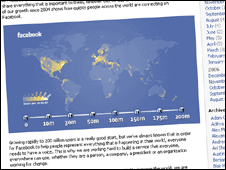 One thing Mr Zuckerberg did to mark this momentous happening was write a blog post. He also announced a new space on Facebook where people can write and share their stories about how Facebook has helped them to give back to their communities, to effect change or to connect with a distant relative. In other words, Facebook community, this is your opportunity to write about how wonderful Facebook is.
They have put a cool timeline on the blog page that shows how fast the community has grown - but really, it underlines how much of the world still has to be conquered by the service. World domination is still some way away, it seems.
But before anyone goes totally negative on the whole online friends routine, a study by IBM and MIT [460Kb PDF] has discovered that there is money to be made from those buddies.
The IBM collaboration with MIT's Sloan School of Management tracked the electronic communications of over 7,000 volunteers for three years. The aim of the work was to put a dollar amount on the effect of those electronic and virtual relationships.
Researchers found that having strong connections to managers (yes, sucking up to the boss) can boost the bottom line. On average, it adds up to $548 (£365) in extra revenue a month.
This conclusion is based on data and mathematical formulas that analysed e-mail traffic, address books and buddy lists of 2,600 IBM consultants over the course of a year.
No word on how those involved in the failed Sun takeover talks rated!
The BBC is not responsible for the content of external internet sites
This is dot.life - a blog about technology from BBC News.
Rory Cellan-Jones is the BBC's technology correspondent.
Maggie Shiels is the BBC's tech reporter based in Silicon Valley.
Archive
« January 2010
| Sun | Mon | Tue | Wed | Thu | Fri | Sat |
|---|---|---|---|---|---|---|
| 1 | 2 | |||||
| 3 | 4 | 5 | 6 | 7 | 8 | 9 |
| 10 | 11 | 12 | 13 | 14 | 15 | 16 |
| 17 | 18 | 19 | 20 | 21 | 22 | 23 |
| 24 | 25 | 26 | 27 | 28 |
Being Discussed Now
- Logging out... and straight back in(3)
- Gadgets of the Noughties(20)
- Plastic Logic's long journey to Vegas(21)
- Sexting teens(17)
- Wikipedia on the wane?(49)
- 'Cooling-off' for mobile phones? Not on the High Street(37)
- 2009 - the social year(36)
- Twitter, Iran and #uksnow(25)
- Broadband Britain - how far down the league?(55)
- Microsoft and Murdoch: Teaming up to bash Google?(34)
BBC Technology Headlines
- %28none%29
%28none%29 - %28none%29
%28none%29 - %28none%29
%28none%29
Visit the Technology index
Visit the BBC News website
Rory's TV/Radio reports
- Residents block Google car
Broadcast: 3 April 2009 - New adverts to tackle film piracy
Broadcast: 2 April 2009 - Call to scrap 'illegal databases'
Broadcast: 23 March 2009 - Female robot takes to the catwalk
Broadcast: 16 March 2009 - Super-charged battery breakthrough
Broadcast: 12 March 2009

- News Editors
- Sport Editors
- Journalism Labs
- BBC Internet Blog
- Radio 4 Blog
- Peston's Picks
- Nick Robinson's Newslog
- Stephanomics
- Mark Easton's UK
- Mark Mardell's America
- Nick Bryant's Australia
- Andrew Harding on Africa
- Gavin Hewitt's Europe
- Soutik Biswas' India
- dot.Rory
- Science: Jonathan Amos
- Richard Black on environment
- Today: Tom Feilden
- Fergus Walsh's medical files
- Newsnight: Paul Mason
- Newsnight: Mark Urban
- Torin Douglas
- Will Gompertz's arts
- Phil Coomes on photojournalism
- Magazine Monitor
- Mark D'Arcy in Westminster
- NI: Mark Devenport
- Scotland: Brian Taylor
- Scotland: Douglas Fraser
- Wales: Betsan Powys
- Martin Rosenbaum on FOI
- 5 Live Breakfast
- Newsnight
- PM programme (iPM)
- World Tonight: Robin Lustig
