


The Battle of Broughton
- 3 Apr 09, 14:00 GMT
On Wednesday, Paul Jacobs spotted a Google Street View car in his village.
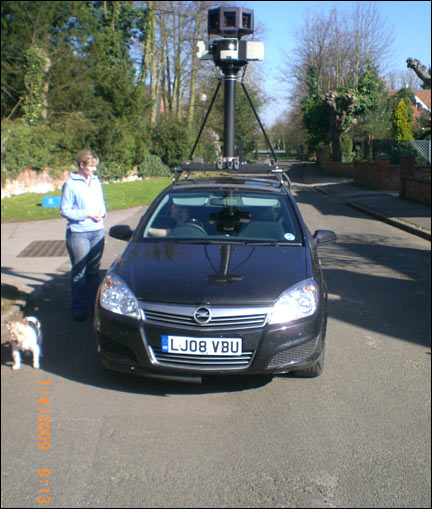
It was executing a nifty turn in the dead-end street just outside his home, and that made him cross, because it appeared that the camera mounted on a pole was peering over his high fence to get a view. He and a neighbour John Holmes rushed out of their homes to confront the driver.
A short while later - after an amicable chat with the man from Street View - the car left this quiet village outside Milton Keynes. It appeared that Broughton could rest easy, with no prospect of cameras shoving their lenses where they're not wanted and invading the privacy of this quiet backwater.
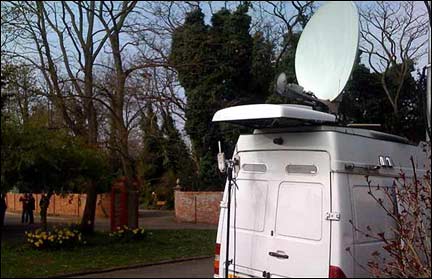
Two days later, I'm here with a large BBC satellite truck and a cameraman - and at least two other camera crews have been spotted in the village this morning. The village was also featured in the local papers yesterday and much of the national press this morning. So how private is this place now?
But make no mistake, the battle of Broughton is another embarrassment for Google - and gives us another interesting angle in the debate over privacy. Just hours after Street View was launched last month, complaints were already coming in about unblurred faces and embarrassing incidents caught on camera.
Google acted quickly to deal with those issues and it appeared that the controversy was over. Millions of us have been using the service - not so much, I suspect, to visit landmarks but to check out that house we used to live in years ago and tut-tut over the nasty shade of paint the new owners have chosen for the front door.
But now - for the first time, as far as I can see - a whole village has revolted. Paul Jacobs insists he's no Luddite or Nimby - and uses Google himself for navigation. He just feels they've overstepped the mark, coming a little too close with their cameras. "I've no objection to them taking wide shots of vistas - it's when they're taking close-ups of people's homes, that crosses the line." His neighbour John Holmes puts it more firmly - "an Englishman's home is his castle" - and wants Street View out of the village altogether.
You may point out to them that estate agents pictures of people's homes are widely available on the internet - they'll respond that those shots are taken with the owners' agreement.
Google says it isn't breaking any law by taking these pictures - they're always shot from the public highway. And by agreeing to black out homes if people aren't happy to have them shown, they're going further than they need to. After all, if you or I want to take a picture in the street and then post it online, there's nothing to stop us.
But what Google is finding again is that its sheer scale and reach makes people nervous. So the people of Broughton seem relatively relaxed about having our cameras pointed down their street. But the idea of any one of Google's hundreds of millions of users making their way down the village streets and peering over the hedge? That, they believe, is a step too far.

Renaming Web 2.0
- 3 Apr 09, 08:28 GMT
At the Web 2.0 Expo in San Francisco, internet guru Tim O'Reilly threw out the possibility that perhaps the name should be changed.
 He said he and his friend John Battelle of Federated Media had been playing around with an alternative which was Web 2.0 + World = Web Squared.
When I asked Mr O'Reilly if he loved or hated the name Web 2.0 that he popularised, he let out a big sigh and said "Awww does it have to be one or the other?"
Eventually he admitted "I love it and I hate it. It's a term that has been very effective and very successful in getting across an idea. I spent a long time talking about that idea around the turn of the Millenium, talking about building the internet operating system. It didn't catch on and all of a sudden we had this new term Web 2.0 and everyone got it so how could you not love that?"
In the end he said "I have mixed feelings about it. I am delighted with its effectiveness, it did what I wanted it to do. To catalyse the industry after the dotcom bust that things weren't over and that something mattered about the companies that had survived. They knew something that the others didn't. And I think that continues to be true.
"The companies that are succeeding today understand better than others what it means to be building software in the age of the internet."
As to really getting behind Web Squared, Mr O'Reilly said "It was just one of these idle thoughts where you go dub dub dub and then you go one more w and that gets you to web squared, right?"
My unscientific research on the expo floor found more people hating than loving the Web 2.0 title.
Paul Thompson said "Keep it. It hasn't been around for very long and you need a few years to build an identity. If you replace it with Web Squared, people will go what happened to Web 2.0?"
Mark Kirthcart thought "it's sounding a little dated and overused."
Sindee Thomson's view was "Web 3.0 will be here soon." For her, Web Squared was a total no no. "I hate it. It reminds me of mathematics and I was never good at my sums. I think it should be Web Cubed."
Brooklynn Morris was a big fan. "I think Web 2.0 is a great title but I think people don't like titles in general especially when it gets in the way of free concepts."
Kevin Marshall said he thought people were "tired of Web 2.0 because of all the hype around it. Web Squared however, I don't think is any better."
Alistair Mitchell suggested that instead of Web Squared it should be "Web Shared because the web today is all about sharing - sharing the content of your life through things like Flickr, Facebook, where you live, where you are and how you work."
Taomas Rio said "Web 2.0 is too techy. Sure the core of people who come here know what it means but the internet is always evolving so why do you need versions or numbers to categorise it?"
As for Web Squared, Taomas was aghast. "Oh no that's web weird!"
Any better suggestions?
The BBC is not responsible for the content of external internet sites
This is dot.life - a blog about technology from BBC News.
Rory Cellan-Jones is the BBC's technology correspondent.
Maggie Shiels is the BBC's tech reporter based in Silicon Valley.
Archive
« January 2010
| Sun | Mon | Tue | Wed | Thu | Fri | Sat |
|---|---|---|---|---|---|---|
| 1 | 2 | |||||
| 3 | 4 | 5 | 6 | 7 | 8 | 9 |
| 10 | 11 | 12 | 13 | 14 | 15 | 16 |
| 17 | 18 | 19 | 20 | 21 | 22 | 23 |
| 24 | 25 | 26 | 27 | 28 |
Being Discussed Now
- Logging out... and straight back in(3)
- Gadgets of the Noughties(20)
- Plastic Logic's long journey to Vegas(21)
- Sexting teens(17)
- Wikipedia on the wane?(49)
- 'Cooling-off' for mobile phones? Not on the High Street(37)
- 2009 - the social year(36)
- Twitter, Iran and #uksnow(25)
- Broadband Britain - how far down the league?(55)
- Microsoft and Murdoch: Teaming up to bash Google?(34)
BBC Technology Headlines
- %28none%29
%28none%29 - %28none%29
%28none%29 - %28none%29
%28none%29
Visit the Technology index
Visit the BBC News website
Rory's TV/Radio reports
- Residents block Google car
Broadcast: 3 April 2009 - New adverts to tackle film piracy
Broadcast: 2 April 2009 - Call to scrap 'illegal databases'
Broadcast: 23 March 2009 - Female robot takes to the catwalk
Broadcast: 16 March 2009 - Super-charged battery breakthrough
Broadcast: 12 March 2009

- News Editors
- Sport Editors
- Journalism Labs
- BBC Internet Blog
- Radio 4 Blog
- Peston's Picks
- Nick Robinson's Newslog
- Stephanomics
- Mark Easton's UK
- Mark Mardell's America
- Nick Bryant's Australia
- Andrew Harding on Africa
- Gavin Hewitt's Europe
- Soutik Biswas' India
- dot.Rory
- Science: Jonathan Amos
- Richard Black on environment
- Today: Tom Feilden
- Fergus Walsh's medical files
- Newsnight: Paul Mason
- Newsnight: Mark Urban
- Torin Douglas
- Will Gompertz's arts
- Phil Coomes on photojournalism
- Magazine Monitor
- Mark D'Arcy in Westminster
- NI: Mark Devenport
- Scotland: Brian Taylor
- Scotland: Douglas Fraser
- Wales: Betsan Powys
- Martin Rosenbaum on FOI
- 5 Live Breakfast
- Newsnight
- PM programme (iPM)
- World Tonight: Robin Lustig
