


Why PlayStation 2 still matters
- 31 Mar 09, 15:30 GMT
Sony has cut the price of its PlayStation 2 console to under $99 in the US and 99 euros across mainland Europe, while it remains at £94 in the UK.
While rumours of a global Sony PlayStation announcement had circulated for days many observers were expecting the firm to announce a price cut for the PlayStation 3.
There is a continued belief that the high price of the PlayStation 3, relative to the Xbox 360 and Wii, coupled with the global downturn is causing ongoing problems for Sony as it battles to compete with Microsoft and Nintendo.
Sony, however, continues to point to its 10-year strategy for the PlayStation 3, and remains steadfast in its belief the platform will not only "come good" but will eventually triumph over the Xbox 360 in terms of global sales.
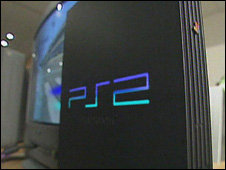 A look at how the PlayStation 2 has developed and evolved over the last nine years presents some clues as to why they believe this is the right strategy.
According to the last financials from Sony, the PS2 had sold 140.2 million worldwide (50.3 million of those in Europe and related territories like the Middle East and Australia) and 1,507.7million units of software.
And it continues to sell well across the world.
More than 5,000 PlayStation 2 consoles are sold each week in Japan, and last month 131,000 PS2s were sold in the US.
If you look at the software sales charts in the US it's clear the big developers are continuing to support the platform.
Pro Evolution Soccer 2009, Fifa 2009, Call of Duty: World at War, Need for Speed and Lego Batman are all riding high in the PS2 charts.
The top-selling game for PS2 at the moment does, however, give a sense of the target demographic for the console: Ben 10: Alien Force, a superhero game for young children.
So why is Sony cutting the cost of a PS2 and not PS3? Simple economics.
While sales of the PS2 are dwindling it continues to be a big money spinner for Sony, which is making money of each and every unit sold.
If Sony cuts the price of the PS3, on which it makes a loss on every console sold, it is likely to lose even more money in the short term.
Piers Harding-Rolls, a senior analyst at Screen Digest, told me: "Sony is looking to extend the life of the PS2 as long as possible to make up for the relatively slow adoption of the PS3.
"Indeed the PS2 remains a substantial source of income for Sony and will become increasingly relevant to emerging markets at this new price point."
This then is the reasoning behind David Reeves, boss of Sony Computer Entertainment Europe, when he comments: "We are very excited about the future of PlayStation 2 and will continue to grow the game library this year, meaning that new and existing owners have plenty to be excited about."
The PS2 is also "massive in emerging territories like India", according to a Sony representative.
More than 450,000 PS2 consoles have been reportedly sold in India since its launch.
"Worldwide PS2 software sales contributed €2bn of total value or 10% of the market in 2008 although it lost €1.5bn in value year-on-year as the platform hit the end years of its lifecycle," explained Mr Harding-Rolls.
It is by no means a device that has been consigned to the dustbin and if Sony is ever going to turn PlayStation 3 into a genuinely profitable enterprise it will to continue to squeeze all the revenue out of the PS2 that it can.
But as Mr Harding-Rolls warned: "Since the domination of the PS2 during the last console cycle, the market has been turned on its head by the incredible performance of Nintendo's Wii and the solid performance of Microsoft's Xbox 360 - it is clear that Sony's dominance will not be repeated this time round."

G20: The social media battle
- 31 Mar 09, 15:01 GMT
Members of the police, it seems, are bracing themselves for trouble on the streets of London as the G20 summit gets underway. But there's also a battle going on in cyberspace, as the various protest movements use all the latest tools to organise.
We've become accustomed to seeing Facebook, Twitter and other social networks used to bring together protesters or to run campaigns. What's different this time is that it's not just opponents and critics of the global get-together who are using these tools - it's also the organisers themselves.
 Let's have a look across the online G20 landscape.
First of all, you've got the usual websites where protesters gather - not very different from what was around in 2003 when major protests against the Iraq war took place in cities around the world.
So, for instance, there's "G20 meltdown", which says it has these three goals:
1. Participate in a carnival party at the Bank of England
2. Support all events demonstrating against the G20 during the meltdown period (from March 28th onwards)
3. Overthrow Capitalism
There is no timetable, I notice, for that last goal. But protesters are also using new tools that weren't widely available in 2003. All sorts of Facebook groups are organising all sorts of events around the G20 summit.
And "G20 meltdown" has one of the biggest with more than 3,000 members. I see that there's a lively discussion on the topic: "Is G20 Meltdown an MI5-backed infowar, propaganda exercise?"
Then, of course there is Twitter - but while this may well be a good way of exchanging information, I doubt that it's a major force in organising demonstrations - one social media expert told me he reckoned Twitter was "an older person's tool" and that young anarchists were unlikely to be tweeting their exploits.
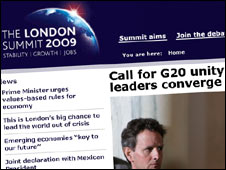 On the other side of the fence, it's not hard to find official G20 material online - websites, Twitter feeds and so on.
But more interestingly, there's what you might call a "third way" - a swathe of social media activity which is sponsored, or encouraged by the government.
One of these projects is Yoosk London Summit, run by a business which is attempting to provide a debating forum where the public can engage directly with politicians. Yoosk says this particular venture allows anyone to put questions direct to "an impressive line-up of ministers, business and civil society leaders" about the financial crisis. I notice that today, for instance, "SadBog74" is asking Gordon Brown:"Should G20 nations agree to tax bailed-out-bank bonuses at a minimum rate of 90%, as Barack Obama has done so in the USA?"
Yoosk is an independent business, but this project has government money behind it - so how independent can it be? Tim Hood of Yoosk told me, "We're walking a fine line - we have a level of access that we wouldn't get otherwise. It's not as independent as we'd like - but we're getting there."
 Then there is G20 Voice - a group of 50 bloggers who are going to be given access to the summit, in an exercise organised by Oxfam but sponsored by the Foreign Office. They range from Daniel Kaufman, a writer on corruption and financial crises to Rui Chenggang, a blogger and financial news presenter for Chinese TV.
Also among them is Lloyd Davis, a British social media consultant who told me that 25 years ago he'd stood on picket lines during the miners' strike but was now a little old for that kind of thing. "They might say we've all been 'captured'," he told me, "but I'm interested in the issues here, and how we can organise our way through this recession or depression."
Mr Davis and his fellow bloggers have had security clearance so that they can get into the Excel centre and attend the press conferences, which means there could be an alternative view of events from that provided by the mainstream media.
So new social media tools can provide ways for demonstrators to wreak havoc on the streets, though they are very public places if you're planning anything you don't want the police to read about. They can be used by governments to parrot an official line about the G20. Or they can provide a forum for a genuinely open-minded debate about a crisis which affects us all. Then again, the Twittering, blogging and Facebooking about the G20 could turn out to be a minority interest. Maybe we're about to find out just how interested young social networkers are in world events rather than in celebrity gossip?
The BBC is not responsible for the content of external internet sites
This is dot.life - a blog about technology from BBC News.
Rory Cellan-Jones is the BBC's technology correspondent.
Maggie Shiels is the BBC's tech reporter based in Silicon Valley.
Archive
« January 2010
| Sun | Mon | Tue | Wed | Thu | Fri | Sat |
|---|---|---|---|---|---|---|
| 1 | 2 | |||||
| 3 | 4 | 5 | 6 | 7 | 8 | 9 |
| 10 | 11 | 12 | 13 | 14 | 15 | 16 |
| 17 | 18 | 19 | 20 | 21 | 22 | 23 |
| 24 | 25 | 26 | 27 | 28 |
Being Discussed Now
- Logging out... and straight back in(3)
- Gadgets of the Noughties(20)
- Plastic Logic's long journey to Vegas(21)
- Sexting teens(17)
- Wikipedia on the wane?(49)
- 'Cooling-off' for mobile phones? Not on the High Street(37)
- 2009 - the social year(36)
- Twitter, Iran and #uksnow(25)
- Broadband Britain - how far down the league?(55)
- Microsoft and Murdoch: Teaming up to bash Google?(34)
BBC Technology Headlines
- %28none%29
%28none%29 - %28none%29
%28none%29 - %28none%29
%28none%29
Visit the Technology index
Visit the BBC News website
Rory's TV/Radio reports
- Residents block Google car
Broadcast: 3 April 2009 - New adverts to tackle film piracy
Broadcast: 2 April 2009 - Call to scrap 'illegal databases'
Broadcast: 23 March 2009 - Female robot takes to the catwalk
Broadcast: 16 March 2009 - Super-charged battery breakthrough
Broadcast: 12 March 2009

- News Editors
- Sport Editors
- Journalism Labs
- BBC Internet Blog
- Radio 4 Blog
- Peston's Picks
- Nick Robinson's Newslog
- Stephanomics
- Mark Easton's UK
- Mark Mardell's America
- Nick Bryant's Australia
- Andrew Harding on Africa
- Gavin Hewitt's Europe
- Soutik Biswas' India
- dot.Rory
- Science: Jonathan Amos
- Richard Black on environment
- Today: Tom Feilden
- Fergus Walsh's medical files
- Newsnight: Paul Mason
- Newsnight: Mark Urban
- Torin Douglas
- Will Gompertz's arts
- Phil Coomes on photojournalism
- Magazine Monitor
- Mark D'Arcy in Westminster
- NI: Mark Devenport
- Scotland: Brian Taylor
- Scotland: Douglas Fraser
- Wales: Betsan Powys
- Martin Rosenbaum on FOI
- 5 Live Breakfast
- Newsnight
- PM programme (iPM)
- World Tonight: Robin Lustig
