


Speed Diary: Your blog posts
- 25 Feb 09, 10:45 GMT
A few bloggers have picked up on my speed tests of the 50Mbps connection I have been carrying out and have carried on the debate.
At Net Strategics Stuart Newstead said:
The blog shows that the advertised headline speed is fairly irrelevant to the actual experience of an average customer, even when the provider can actually deliver such speeds reliably within the confines of their own network.
I agree. While many of the benchmark tests and real world tests I carried out reached close to the advertised maximum speed, the most important aspect of all was the sense of speed and the appreciation that tasks which once took an age were now happening must faster.
At Fibre to the Home blog Cybersavvy noted:
His very first sentence is wrong. He is only one of the broadband elite in the UK!! Far too many other countries' consumers would think 50Mbps/1.5Mbps is not a particularly great connection in 2009....
That may be true of countries like South Korea but as Professor Leonard Waverman's Connectivity Scorecard recently showed the UK "is one of the
few countries in which a mainstream incumbent operator offers 50 Mbps services. "
Over at Fibre Revolution Fibre Guy remarks,
Does the quality of the link degrade over time? It's a sad reality of network that they're super cool when they're (comparatively) empty and get really bad when new customers join.
I'll certainly be keeping a regular eye on the connection speed.
And finally, ISP Review gave a welcome nod to the tests on the site. Thanks for the link.

Who profits from the App Store?
- 25 Feb 09, 10:03 GMT
You will struggle to find a happy shopkeeper right now - but I've just met one. His name is Eric, and he has good reason to be contented. After all his store only opened in July last year, but has already sold 500 million products, and its deal with its suppliers means it gets 30% of the revenues. And as the store is in cyberspace, it is cheap to run and most of that revenue is profit.
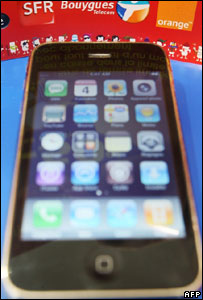 I'm talking, of course, about Apple's App Store, which has created a whole new industry of mobile application developers. Yes, I know that Nokia and Windows Mobile users have been able to install applications on their phones for years - but the figures show that it was only the arrival of the iPhone which sparked real interest from both users and developers.
The company called me in to the Apple Store on London's Regent Street to meet Eric Jue. His title is "Senior Product Manager for iPhone", which I think means he minds the Apps Store. Eric was keen to give me a sneak preview of some upcoming applications - all of them games, which apparently account for 25% of downloads.
They included Sway, where you climb across a wall until you fall off, and Zen Bound, where you wrap a rope around a 3D object and paint it different colours. "Why?, I asked. "It's a game - it's a zen thing", came the answer. I was more impressed by something called WordFu, a sort of cross between Boggle and Scrabble, in which you race to make words in two minutes, and can play against a friend if you both happen to have an iPhone on the same wireless network.
All of these were relatively simple affairs made by tiny firms, with a handful of staff. But businesses like the games giant EA are also weighing in. Eric Jue showed me a version of their Tiger Woods golf game, due for release in the summer, with some pretty stunning graphics, evidence that the iPhone is being taken seriously as a gaming platform.
I'd come armed with questions about some notable gaps on the shelves of the apps store from users and developers who wondered whether Apple was deliberately blocking admission to some ideas. For instance, where are the sat-nav applications? Google maps doesn't really quite do the trick if you're driving because there is no voice guide. Will Apple allow music services like Spotify to offer mobile applications, risking iTunes sales? And does Apple make it easier for big developers to get their applications through than the smaller developers?
Eric Jue insisted that any idea was welcome, as long as it met Apple's terms and conditions - only something that might seriously offend would be refused. He said there was a level playing field. "Everybody has the same tools - whether you're a bedroom developer or you're EA Sports with a big budget. The public decides whether it's a success or not."
Among the biggest successes are the Ocarina, which turns the iPhone into a musical instrument and has reaped big profits for its creators, who include a Stanford professor of computing and music. But is it really that easy to make your fortune from mobile phone apps? Not according to two British developers.
Jeremy Rayner, who describes himself as a "hobby" developer says he developed his game "Rabbit Run" on his train commute from Hastings to his day job in London. It sells for £1.19 and after Apple's 30% and the tax is deducted, he ends up with 50p. "Initially, I got about 30 downloads a day, but that's now down to about one a day." So an income of 50p a day? "Yes, but that's 50p I didn't have before." Mr Rayner says he's glad to get on the same platform as giant firms, but does wonder a little how he might promote his game a bit better.
Riccardo Ettore has been developing Apple software for more than 20 years, but again he does it in his spare time from his job as an IT administrator. He has a range of iPhone apps, including Big Ben, which puts the famous clock face onto the phone, and - perhaps more useful - Tapit4me, a so-called snippet expander which allows you to tap out whole words from abbreviations, making it quicker to use the iPhone's touch keyboard.
Mr Ettore says it's getting harder, not easier to make money, as the field gets more crowded." In the early days people just downloaded anything. My first application, a xylophone, got 200 downloads on its first day." He thought Big Ben was going to be a big money spinner when a free version was downloaded 3000 times in a couple of days, but when he started charging 59p, just 20 people a day thought it worth paying. "What seems to be happening is that most people expect all applications to be free," he laments. "You hear all these incredible stories like Ocarina, but it's like buying a lottery ticket."
Still, both of these hobbyists seem happy enough to keep on churning out applications for the iPhone and the iPod Touch for little or no return. And Apple is even happier - all those tiny amounts earned by the "long tail" of App Store developers add up to a big fat profit for the shopkeeper. And even if users gradually decide that most apps are not worth paying for, Apple will have succeeded in getting a lot of software which makes the iPhone more useable for nothing.

The woman with the midas touch
- 25 Feb 09, 09:10 GMT
Chris Shipley has been called everything from a "Woman of Distinction" to one of the "Top 10 Minds in Small Business."
 Chris Shipley has been called everything from a "Woman of Distinction" to one of theOutside of the Valley, her name may not be as familiar as other top females executives like Meg Whitman, Carol Bartz or Carly Fiorina. But her influence is just as impressive.
For the last 13 years she has been responsible for bringing more than 1,500 new products to market including Java and Palm Pilot . Every year she meets with more than 500 companies before whittling that number down to a handful who are invited to launch at DEMO,which is regarded as a major launch pad for start-ups.
Over the years some of those products and companies put under the spotlight have included BitGravity, Green Plug, LeapFrog Enterprises, Six Apart, Trend Micro, NASA Ames Research, Handspring, Autonomy and Mobio.
While the companies might not be household names, in the industry these starts-ups get tagged as the ones to watch and often end up being acquired by others. For example Homestead Technologies was bought by Intuit for $170m, CISCO bought Ironport for $830m and HP purchased Bitfone for an undisclosed sum.
Next year will be Ms Shipley's last running the conference, and later on Wednesday I will get the opportunity to sit down with her and talk to her about her years at the helm.
While I have my own thoughts about what I want to ask her, I figured this was a great opportunity to find out if you have any questions for the woman who has been at the centre of the start-up world for so many years.
The BBC is not responsible for the content of external internet sites
This is dot.life - a blog about technology from BBC News.
Rory Cellan-Jones is the BBC's technology correspondent.
Maggie Shiels is the BBC's tech reporter based in Silicon Valley.
Archive
« January 2010
| Sun | Mon | Tue | Wed | Thu | Fri | Sat |
|---|---|---|---|---|---|---|
| 1 | 2 | |||||
| 3 | 4 | 5 | 6 | 7 | 8 | 9 |
| 10 | 11 | 12 | 13 | 14 | 15 | 16 |
| 17 | 18 | 19 | 20 | 21 | 22 | 23 |
| 24 | 25 | 26 | 27 | 28 |
Being Discussed Now
- Logging out... and straight back in(3)
- Gadgets of the Noughties(20)
- Plastic Logic's long journey to Vegas(21)
- Sexting teens(17)
- Wikipedia on the wane?(49)
- 'Cooling-off' for mobile phones? Not on the High Street(37)
- 2009 - the social year(36)
- Twitter, Iran and #uksnow(25)
- Broadband Britain - how far down the league?(55)
- Microsoft and Murdoch: Teaming up to bash Google?(34)
BBC Technology Headlines
- %28none%29
%28none%29 - %28none%29
%28none%29 - %28none%29
%28none%29
Visit the Technology index
Visit the BBC News website
Rory's TV/Radio reports
- Residents block Google car
Broadcast: 3 April 2009 - New adverts to tackle film piracy
Broadcast: 2 April 2009 - Call to scrap 'illegal databases'
Broadcast: 23 March 2009 - Female robot takes to the catwalk
Broadcast: 16 March 2009 - Super-charged battery breakthrough
Broadcast: 12 March 2009

- News Editors
- Sport Editors
- Journalism Labs
- BBC Internet Blog
- Radio 4 Blog
- Peston's Picks
- Nick Robinson's Newslog
- Stephanomics
- Mark Easton's UK
- Mark Mardell's America
- Nick Bryant's Australia
- Andrew Harding on Africa
- Gavin Hewitt's Europe
- Soutik Biswas' India
- dot.Rory
- Science: Jonathan Amos
- Richard Black on environment
- Today: Tom Feilden
- Fergus Walsh's medical files
- Newsnight: Paul Mason
- Newsnight: Mark Urban
- Torin Douglas
- Will Gompertz's arts
- Phil Coomes on photojournalism
- Magazine Monitor
- Mark D'Arcy in Westminster
- NI: Mark Devenport
- Scotland: Brian Taylor
- Scotland: Douglas Fraser
- Wales: Betsan Powys
- Martin Rosenbaum on FOI
- 5 Live Breakfast
- Newsnight
- PM programme (iPM)
- World Tonight: Robin Lustig
