


Speed Diary: Day Five
- 23 Feb 09, 14:50 GMT
A number of readers of this blog and my Twitter followers were kind enough to suggest different ways to test our 50Mbps cable broadband connection, as part of a Speed Diary I've been carrying out over the last week.

So here they are. I should also point out that I performed all of these tests over a wireless connection. They would have been faster over an Ethernet connection.
Try using a download manager and downloading a file from ftp.virginmedia.com then uploading it to /incoming
There are a number of game demo files sitting on the Virgin FTP (File Transfer Protocol) site and I was able to easily saturate the downstream speeds getting very close to the 50Mbps upper limit. Each of the five files I simultaneously downloaded was coming down at almost 1.0MB per second.
On the upload site I was getting around 1Mbps.
Two readers suggested downloading some TV programmes via BitTorrent and The Pirate Bay. One reader said: "In the name of journalistic research and only to watch Beeb programs of course."
Given the current court case against The Pirate Bay going on in the Swedish courts, it is probably not a good career move to be downloading any unauthorised content via The Pirate Bay, even material from my own employer without permission.
So I used LegalTorrents.com to download some video files covered under a Creative Commons license for free distribution.
A 900MB file being shared by 25 peers on BitTorrent came down the pipe at about 400 to 500KBps in about 40 minutes. In my experience the more seeders there are on BitTorrent sharing a file, the quicker it tends to arrive so a more popular file would have been downloaded faster.
A number of users suggested downloading files from news servers, such as Giganews and the Virgin Media news server
News servers pre-date the World Wide Web and are both text discussion boards and a method of distributing large files, often it has to be said copied movies, TV programmes and music. But there are also game demos, and copyright-free material to be found.
The advantage of news servers over tools like BitTorrent is speed. Most providers of news servers have incredibly quick connections and downloading files is often only limited by the speed of your own broadband connection.
I downloaded a 350MB file from both GigaNews and the news server operated by Virgin Media. The file downloaded via GigaNews came down the pipe at between 4MB per second 4.2MB per second, which is pretty much the top end of my connection speed.
The Virgin Media news server was a little bit slower - with a minimum of 1MB per second and a maximum of 3.9MB per second.
How about a download of a large game/demo on a console?
So how quickly can you download files from a service like Xbox Live? I selected the demo of strategy game Halo Wars to download, a file over 1GB in size.
The demo was downloaded and playing on my Xbox 360 in under eight minutes.
What are the speeds like when e-mailing high resolution images, such as 50MB photos?
It is very difficult to find a mail service that will accept files as big as 50MB, and it is probably more advisable to use FTP, BitTorrent or a file transfer service like YouSendIt, or SendThisFile.
Google Mail accepts attachments up to 20MB in size. I sent two JPGs of about 8MB in size each using Google's mail service. The files left my outbox within five minutes.
How about streaming video on 2-3 clients simultaneously? Can it cope?
I wrote about this last week. To recap: I streamed the BBC's iPlayer across three machines with little difficulty but as soon as I threw in some background downloads of large files then the picture started to stutter on one of the machines.
Try Xbox 360 racing games, not FPS. Try hosting Forza 2 session with maximum racers.
Last week I used the connection to play some First Person Shooter games with some mixed results. I don't have a copy of Forza 2 but I do have a copy of Project Gotham Racing 4. I hosted a number of races and all of the gamers in my session reported the session was lag free.
Schedule daily speed tests and record the results over time to see if, as the success of the service increases the quality does not decrease (something that has often been seen in cable broadband).
Virgin says there is no bandwidth throttling on the connection of users of its 50Mbps service - something that is not true of its other connection speeds.
I took readings of the connection speed from a number of different measurement tools across the week and found there was a slight variance in the speed.
On wired connections, the tests revealed that the speeds varied from 36Mbps to 48Mbps over the period.
On wireless connections - once I had fixed my router issues - the speeds varied between 25Mbps and 46Mbps during the week.
There was one reader request that I was not able to help with, however.
Could you download the internet for me and put it on a CD please?
I think I draw the line at that test.
Finally, having the luxury of a 50Mbps service has reminded me how much has changed in term of connection speeds in the last 25 years that I have been online.
I stumbled across my first ever modem recently - a Commodore 64 Communications modem that I used to connect to Compunet when I was a teenager.
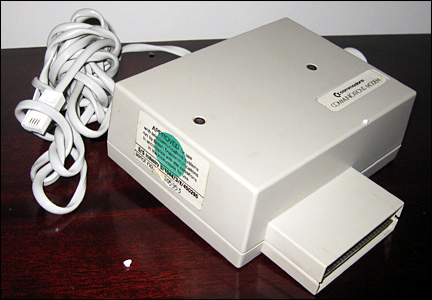
This was a 1200/75 baud modem which means, if I've got my calculations right, that the maximum downstream speed I could have reached was about 1Kbps.
That means that I had been using that modem today and tried to download the Halo Wars demo - it would have taken about 97 days to download, rather than the eight minutes on the 50Mbps connection.
I think it is safe to say that we have made some great leaps in terms of internet connection speeds over the last 25 years.

Can we block child abuse sites?
- 23 Feb 09, 10:05 GMT
Children's charities are accusing the government and the internet service providers of a failure to ensure that all domestic broadband users cannot get access to sites showing child abuse images. This is a battle over the merits of self-regulation versus legislation.
 But it's also another row over the Internet Watch Foundation, the charity which has been acting as a self-appointed - if widely supported - policeman of child abuse sites for many years. Last December the IWF was widely criticised for blocking a Wikipedia page about the 1976 Scorpions' album Virgin Killer because it featured a naked young girl. The IWF quickly reversed that decision - but web libertarians saw the incident as evidence of internet "regulation creep".
The big ISPs all use the IWF's list of banned sites, which is updated twice a day after the charity's staff examine questionable sites reported to them by members of the public. The process, as we discovered during the Wikipedia row, is automatic. Once the ISPs have signed up to the list, then whenever their users click on any link, that URL is checked against their list, and customers get a "website not found" error message if there is a match.
But why has a minority decided to opt out - or rather not opt in? The Internet Service Providers Association told me that cost was an issue - the system was potentially probitively expensive for smaller ISPs to implement, in particular those that mainly served business customers with just a few domestic users. I'm still not clear why that should be the case and indeed the one company I've spoken to which doesn't use the list cites completely different reasons.
That company was Zen Internet, a small Rochdale-based ISP with a reputation for great customer service (in the interests of full disclosure, I'm a customer). They provided me with this statement: "Zen Internet has not yet implemented IWF's recommended system because we have concerns over its effectiveness. Our Managing Director, Richard Tang, is going to meet Peter Robbins the Chief Executive of the IWF to discuss these concerns."
I was also pointed towards the work of Dr Richard Clayton, a Cambridge computer scientist who has been a long-term critic of aspect of the Internet Watch Foundation's work. He has written at length about technical aspects of the blocking system - but his overall conclusion is that the blacklist is just a waste of time. Why? Because most of this material is held abroad and the IWF is ineffective about getting it removed.
He told me that, if the aim was to stop people coming across these images by accident, then the system was a failure because that didn't happen anyway: "This material tends to be held on paid-for sites or is held by people who don't publish it to the world because they don't want to get arrested."
Dr Clayton's view is that the big ISPs use the system because they've been pressured to adopt it, but smaller firms are perfectly justified in opting out. "Everybody thinks they've done something by blocking this stuff but in practice it makes very little difference to who sees it and it's quite expensive."
For its part, the Internet Watch Foundation says it has neither the powers nor the resources to act as a global policeman. The charity says the only real solution is to remove the offending material at its source - but it insists that its list is part of a "layered approach" which can disrupt the activities of the child pornography merchants and protect innocent users.
The charities want the government to get heavy with the 5% of ISPs who are refusing to adopt the Internet Watch Foundation list. "The idea that blocking child pornography is an optional extra we do not accept," one charity official told me. "It is technically possible and should be counted as the cost of doing business in the United Kingdom." But Richard Clayton suspects that a mood of realism has infected ministers, who will be satisfied with 95% compliance by the broadband providers: "The government has seen sense," he told me, "and has decided that legislation is inappropriate."
It would be hard to find anyone who thinks that blocking access to images of child abuse is a bad idea. But getting agreement on how to set about that task is a whole lot harder.
The BBC is not responsible for the content of external internet sites
This is dot.life - a blog about technology from BBC News.
Rory Cellan-Jones is the BBC's technology correspondent.
Maggie Shiels is the BBC's tech reporter based in Silicon Valley.
Archive
« January 2010
| Sun | Mon | Tue | Wed | Thu | Fri | Sat |
|---|---|---|---|---|---|---|
| 1 | 2 | |||||
| 3 | 4 | 5 | 6 | 7 | 8 | 9 |
| 10 | 11 | 12 | 13 | 14 | 15 | 16 |
| 17 | 18 | 19 | 20 | 21 | 22 | 23 |
| 24 | 25 | 26 | 27 | 28 |
Being Discussed Now
- Logging out... and straight back in(3)
- Gadgets of the Noughties(20)
- Plastic Logic's long journey to Vegas(21)
- Sexting teens(17)
- Wikipedia on the wane?(49)
- 'Cooling-off' for mobile phones? Not on the High Street(37)
- 2009 - the social year(36)
- Twitter, Iran and #uksnow(25)
- Broadband Britain - how far down the league?(55)
- Microsoft and Murdoch: Teaming up to bash Google?(34)
BBC Technology Headlines
- %28none%29
%28none%29 - %28none%29
%28none%29 - %28none%29
%28none%29
Visit the Technology index
Visit the BBC News website
Rory's TV/Radio reports
- Residents block Google car
Broadcast: 3 April 2009 - New adverts to tackle film piracy
Broadcast: 2 April 2009 - Call to scrap 'illegal databases'
Broadcast: 23 March 2009 - Female robot takes to the catwalk
Broadcast: 16 March 2009 - Super-charged battery breakthrough
Broadcast: 12 March 2009

- News Editors
- Sport Editors
- Journalism Labs
- BBC Internet Blog
- Radio 4 Blog
- Peston's Picks
- Nick Robinson's Newslog
- Stephanomics
- Mark Easton's UK
- Mark Mardell's America
- Nick Bryant's Australia
- Andrew Harding on Africa
- Gavin Hewitt's Europe
- Soutik Biswas' India
- dot.Rory
- Science: Jonathan Amos
- Richard Black on environment
- Today: Tom Feilden
- Fergus Walsh's medical files
- Newsnight: Paul Mason
- Newsnight: Mark Urban
- Torin Douglas
- Will Gompertz's arts
- Phil Coomes on photojournalism
- Magazine Monitor
- Mark D'Arcy in Westminster
- NI: Mark Devenport
- Scotland: Brian Taylor
- Scotland: Douglas Fraser
- Wales: Betsan Powys
- Martin Rosenbaum on FOI
- 5 Live Breakfast
- Newsnight
- PM programme (iPM)
- World Tonight: Robin Lustig
