


A lesson from tech hell
- 15 Jan 09, 16:25 GMT
It was meant to be a day in which I learned about the role technology is now playing in education - but it turned into a painful lesson in how technology can bite you. A visit to BETT, the ICT-in-education show, seemed a great idea.
I've long felt that the story of the ICT revolution in schools has not been properly examined - certainly by me. After all, the government has invested £5bn in giving schools in England everything from broadband connections to electronic whiteboards - but are we clear that there has been an educational dividend from that investment?
So I promised the News Channel a series of live broadcasts and the News At One a taped report from the show. Cue total tech disaster - everything that could go wrong did go wrong.
First of all, our satellite truck just couldn't lock onto a signal outside Olympia - and by the time it found one, we were too busy putting together our One O'Clock package to go live.
We finished editing in a cubby hole, kindly lent us by the organisers, at exactly 1300 GMT - not unusual in a world where we work very close to the wire. The report was due on air at 1320 GMT so we had plenty of time to export it to tape from the laptop where it had been edited with the Avid program and take it outside to the satellite truck. First problem - the laptop simply refused to export the file to tape.
Undaunted, my cameraman/picture editor suggested we should just plug his laptop into the truck via a Firewire cable. Cue frantic search for the right cable - and then by 1310 GMT we were ready to feed. No cause for panic, then - until the laptop crashed. Every time we tried to launch Avid, we got an incomprehensible error message. We crept closer and closer to our slot, with me jumping up and down in despair. Finally, we had to admit failure - and the bulletin had to do without our report. In the circumstances, my bosses were very understanding - though there were the usual jibes about a technology correspondent at a technology show being let down by technology.
Which set me thinking. The problem with advances in the technology we use - whether in journalism or the classroom - is that they can impose huge stress on those who use them. I walked round the BETT show admiring all the tools that are now available to today's teachers - from netbooks, through electronic whiteboards, to the cheap cameras being wielded by an enthusiastic group of students from a London school making their own report about the show.
But then I remembered what one very experienced teacher had told me a few weeks ago. He said the best form of teaching was still all about chalk and talk, and that the technology had been a hindrance not a help. He described student teachers overburdened with work and losing confidence because they now felt that they had to prepare a Powerpoint presentation for every lesson on the electronic whiteboard.
Now, I do think this particular teacher - though he denied it - was from the Luddite tendency. But I think the point about stress was well made. In all my years editing pieces out in the field on tape, I can never remember an occasion when machine failure has stopped us getting on air. But twice in the last couple of years a laptop has refused to spew out my precious report - leaving both me and the editor helpless. With the old machines, you could at least bash them - somehow laptops don't respond to that treatment.
Let me be clear - I do believe that just about all these advances in the technology used by both teachers and journalists are worthwhile. But each time a transition comes along, there is bound to be a lot of stress for the practitioners - and that is sometimes ignored by their manager.
Anyway, eventually we did get the video files out of one laptop and onto another, and our report was finally shown on the News Channel. In case you missed it, you'll find it embedded here - but what it doesn't show is any of the pain involved in making it.
In order to see this content you need to have both Javascript enabled and Flash installed. Visit BBC Webwise for full instructions. If you're reading via RSS, you'll need to visit the blog to access this content.

Steve Jobs: The fallout
- 15 Jan 09, 09:23 GMT
The fact that Steve Jobs' admission that his health issues "are more complex that originally thought" really comes as no surprise.
When he sent his letter to the Apple faithful ahead of Macworld last week saying he was suffering from a "hormonal imbalance", everyone waited for what was coming next.
It now has. And the third piece of information - that Mr Jobs is taking a leave of absence - caught everyone on the back foot.
Naturally, many are worried that he is now saying his health is worse than he thought, but relieved that the "'c" word was mentioned nowhere in the three paragraph communique. Mind you: does that really matter? The markets are so jumpy about the whole affair that if the guy sneezes, the share price drops.
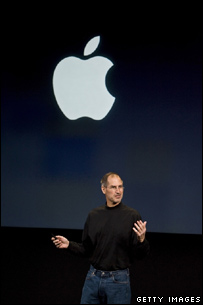 Another reason for taking time off work is the fact that Mr Jobs feels that "the curiosity over my personal health continues to be a distraction not only for me and my family, but everyone else at Apple as well".
Alas, that is not about to change.
Come the summer, if Mr Jobs is not back at the helm and if he perhaps misses Apple's own World Wide Developer Conference, bet your bottom dollar that share price will yo-yo all over the place.
The Silicon Alley Insider makes an interesting point about the whole affair. The blog suggests that lawyers are presently sharpening their teeth to launch a shareholder lawsuit over what Mr Jobs knew about his health and when he knew it. The argument about how much a senior executive should reveal about his or her health when running a public company just won't go away.
And while it seems crass and in bad taste to raise this as an issue, it is certainly something that may lurk in the background.
Apple, of course, is not alone in having bad news to announce.
Google has announcements about cutting jobs concerning 100 recruiters, closing some engineering offices and axing a range of products. Microsoft is also exploring job cuts.
One final piece of Silicon Valley twittering: Techmeme's Gabe Rivera tweets that this is a perfect time for other companies to get out their bad news while attention is elsewhere. We can be sure of two things: first, there's certainly plenty of bad news to go around and second, we do live in cynical times.
The BBC is not responsible for the content of external internet sites
This is dot.life - a blog about technology from BBC News.
Rory Cellan-Jones is the BBC's technology correspondent.
Maggie Shiels is the BBC's tech reporter based in Silicon Valley.
Archive
« January 2010
| Sun | Mon | Tue | Wed | Thu | Fri | Sat |
|---|---|---|---|---|---|---|
| 1 | 2 | |||||
| 3 | 4 | 5 | 6 | 7 | 8 | 9 |
| 10 | 11 | 12 | 13 | 14 | 15 | 16 |
| 17 | 18 | 19 | 20 | 21 | 22 | 23 |
| 24 | 25 | 26 | 27 | 28 |
Being Discussed Now
- Logging out... and straight back in(3)
- Gadgets of the Noughties(20)
- Plastic Logic's long journey to Vegas(21)
- Sexting teens(17)
- Wikipedia on the wane?(49)
- 'Cooling-off' for mobile phones? Not on the High Street(37)
- 2009 - the social year(36)
- Twitter, Iran and #uksnow(25)
- Broadband Britain - how far down the league?(55)
- Microsoft and Murdoch: Teaming up to bash Google?(34)
BBC Technology Headlines
- %28none%29
%28none%29 - %28none%29
%28none%29 - %28none%29
%28none%29
Visit the Technology index
Visit the BBC News website
Rory's TV/Radio reports
- Residents block Google car
Broadcast: 3 April 2009 - New adverts to tackle film piracy
Broadcast: 2 April 2009 - Call to scrap 'illegal databases'
Broadcast: 23 March 2009 - Female robot takes to the catwalk
Broadcast: 16 March 2009 - Super-charged battery breakthrough
Broadcast: 12 March 2009

- News Editors
- Sport Editors
- Journalism Labs
- BBC Internet Blog
- Radio 4 Blog
- Peston's Picks
- Nick Robinson's Newslog
- Stephanomics
- Mark Easton's UK
- Mark Mardell's America
- Nick Bryant's Australia
- Andrew Harding on Africa
- Gavin Hewitt's Europe
- Soutik Biswas' India
- dot.Rory
- Science: Jonathan Amos
- Richard Black on environment
- Today: Tom Feilden
- Fergus Walsh's medical files
- Newsnight: Paul Mason
- Newsnight: Mark Urban
- Torin Douglas
- Will Gompertz's arts
- Phil Coomes on photojournalism
- Magazine Monitor
- Mark D'Arcy in Westminster
- NI: Mark Devenport
- Scotland: Brian Taylor
- Scotland: Douglas Fraser
- Wales: Betsan Powys
- Martin Rosenbaum on FOI
- 5 Live Breakfast
- Newsnight
- PM programme (iPM)
- World Tonight: Robin Lustig
