


Negroponte - missionary not manufacturer
- 18 Dec 08, 10:25 GMT
It was one of the more arresting moments of my broadcasting career. In the middle of our interview, Nicholas Negroponte picked up a laptop on the coffee table in front of him and flung it across the room.
But this was not just any laptop - it was the machine created by Mr Negroponte's One Laptop Per Child organisation. And he wasn't furious with me, just trying to make a point about the rugged virtues of the XO laptop in a very graphical manner.
In order to see this content you need to have both Javascript enabled and Flash installed. Visit BBC Webwise for full instructions. If you're reading via RSS, you'll need to visit the blog to access this content.
But you could forgive the digital guru for being just a little exasperated. After all I had started out, by asking him whether the OLPC project had stalled, overtaken by the rival Intel Classmate laptop and by a host of small notebooks at rock-bottom prices.
This month, OLPC launches its "Give On, Get One" campaign in the UK, urging shoppers to buy the XO for themselves, while giving one to a child in the developing world. But in this offer the "$100 laptop" costs £275 - and, as I pointed out, you can go into a supermarket right now and buy a notebook computer for under £200.
That was why he sent the XO spinning across the floor to demonstrate one way in which it is superior to rival products. Last year I watched as children in a dusty Nigerian village gave the machine some rigorous road-testing, so I was already aware that it was both more unbreakable and less power-hungry than other machines - and more easy to look at in bright sunlight.
But this has not been a great year for this project which aims to put laptops in the hands of millions of children across the developing world. So far, just 600,000 laptops have been delivered, rather than the millions forecast by now, and Uruguay is the only country where they are finding their way into every school. Intel announced in the summer that it is selling 500,000 of its Classmate computers to one country, Portugal.
But Mr Negroponte - who fell out very badly with Intel a year ago - says that's all corporate spin, and he is delivering computers now rather than promising them in the future. He suggests that his project will reach children in countries like Haiti and Ethiopia which commercial organisations will ignore: "We view children as a mission, not a market."
Unfortunately, many of the developing world politicians who once seemed keen to buy into OLPC seem to have lost interest. Nicholas Negroponte fears that is because they do not really understand its educational aims: "If a head of state thinks children should be computer literate - whatever that means - then they don't understand this as part of early stage learning." What he seems to be saying is that it is all about learning how to learn, rather than working out how to create a Word document.
Which bring us to the issue which has led some of OLPC's supporters to doubt the founder's own adherence to its creed, the decision to work with Microsoft. The version of the XO laptop that went skidding across the floor was a dual boot machine, able to run a version of Windows XP alongside its own Linux-based operating system. To some that is a betrayal of the project's original open source creed - and indeed in our interview Mr Negroponte spoke dismissively of other cheap laptops as "diminutive Office products".
But, having outlined the visionary mission behind OLPC, he turned into a pragmatist when I asked him why he was putting Windows on the XO: "It will increase the number of kids who get access to it - because the decision makers are often people who are comfortable with Windows - they're not comfortable with Linux." He compared it to Apple's move to enable users to run Windows on its machines which he said had turned the Mac from a niche product into one which corporate IT departments would approve.
I'm a little worried, however, that the XO may be an idea whose time has come - and gone. Earlier this year OLPC unveiled a prototype of a touchscreen laptop which looked absolutely gorgeous. The trouble is, it's still just a "concept computer" and, as Nicholas Negroponte conceded, could be years from production. In the meantime, commercial manufacturers will be taking the ideas and turning them into profitable products.
As someone who has seen at first hand how inspirational the XO can be - not only for those Nigerian children but in the hands of my own son when I asked him to review it - I would be sad to see this project fade away.
But in a way it has already succeeded. Nicholas Negroponte's skills are those of a missionary rather than a manufacturer. Others may not quite see the mission to bring cheap computing to the world's children in his terms, but they are at least beginning to get the job done.

What gives at Apple?
- 18 Dec 08, 09:35 GMT
Apple's decision to withdraw from future Macworld Expo's after January's is done and dusted has stunned Mac lovers who flock here year after year almost as part of a pilgrimage. The journey is twofold. To hear about new products the company believes will change the world and to listen and watch Apple guru Steve Jobs weave his magic on stage.
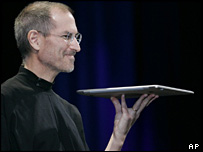 Well at least the fans are being given the chance to revel in all things Apple this one last time. But it truly won't be the same because as well as saying sayonara to the Mac gig, Mr Jobs has decided to pull the plug on presenting the keynote speech at the conference.
He certainly seemed to delight in these set pieces of theatre and the waves of cheers and applause that generally greets his every utterance. So I guess this aspect, among many, makes one ponder why he decided not to give a swansong performance this one last time.
Of course we know there is lots of speculation about his health following a bout of pancreatic cancer four years ago. The issue raised its head earlier this year when Mr Jobs appeared thin and gaunt at the Apple World Wide Developers Conference in San Francisco.
And while he refused to discuss the issue, or let anyone at Apple discuss it publicly, there was the faux pas by one publication in printing his untimely demise. At least the Apple CEO was able to see the funny side of it all when he appeared at an iPod launch in September in front of a giant screen highlighting talk of his death.
But the rumours about his health never went away, and now they have been reignited with this latest piece of news.
When I asked Apple spokesman Steve Dowling about Mr Jobs' health, I thought the line had gone dead because of the silence at the other end. No amount of questions on the topic allicited a response.
Alas that just leaves people like me, analysts, bloggers, Mac fans and so on and so on to fill the vacuum. And there is nothing a story loves more than a vacuum because that is when all sorts of theories are cast among us and allowed to take seed.
Of course there is another theory that has taken root of late and that is that Mr Jobs is looking to help groom a successor. While he may well continue to be a pitchman for Apple at other standalone events, he may slowly pass the reigns of power to others in the company.
So come on down Phil Schiller, who is Apple's head honcho of product marketing, who will stand in for Mr Jobs by presenting the keynote speech at Macworld. No pressure on him then!
Another theory for Mr Jobs' reluctance to take centre stage is that Apple doesn't have much of anything to announce come January. Previous Macworlds have spawned the iPhone, iTunes and the MacBook Air book amongst others.
Whatever the reason for Mr Jobs' no show decision he and the company have succeeded in one thing; everyone is talking about them.
The BBC is not responsible for the content of external internet sites
This is dot.life - a blog about technology from BBC News.
Rory Cellan-Jones is the BBC's technology correspondent.
Maggie Shiels is the BBC's tech reporter based in Silicon Valley.
Archive
« January 2010
| Sun | Mon | Tue | Wed | Thu | Fri | Sat |
|---|---|---|---|---|---|---|
| 1 | 2 | |||||
| 3 | 4 | 5 | 6 | 7 | 8 | 9 |
| 10 | 11 | 12 | 13 | 14 | 15 | 16 |
| 17 | 18 | 19 | 20 | 21 | 22 | 23 |
| 24 | 25 | 26 | 27 | 28 |
Being Discussed Now
- Logging out... and straight back in(3)
- Gadgets of the Noughties(20)
- Plastic Logic's long journey to Vegas(21)
- Sexting teens(17)
- Wikipedia on the wane?(49)
- 'Cooling-off' for mobile phones? Not on the High Street(37)
- 2009 - the social year(36)
- Twitter, Iran and #uksnow(25)
- Broadband Britain - how far down the league?(55)
- Microsoft and Murdoch: Teaming up to bash Google?(34)
BBC Technology Headlines
- %28none%29
%28none%29 - %28none%29
%28none%29 - %28none%29
%28none%29
Visit the Technology index
Visit the BBC News website
Rory's TV/Radio reports
- Residents block Google car
Broadcast: 3 April 2009 - New adverts to tackle film piracy
Broadcast: 2 April 2009 - Call to scrap 'illegal databases'
Broadcast: 23 March 2009 - Female robot takes to the catwalk
Broadcast: 16 March 2009 - Super-charged battery breakthrough
Broadcast: 12 March 2009

- News Editors
- Sport Editors
- Journalism Labs
- BBC Internet Blog
- Radio 4 Blog
- Peston's Picks
- Nick Robinson's Newslog
- Stephanomics
- Mark Easton's UK
- Mark Mardell's America
- Nick Bryant's Australia
- Andrew Harding on Africa
- Gavin Hewitt's Europe
- Soutik Biswas' India
- dot.Rory
- Science: Jonathan Amos
- Richard Black on environment
- Today: Tom Feilden
- Fergus Walsh's medical files
- Newsnight: Paul Mason
- Newsnight: Mark Urban
- Torin Douglas
- Will Gompertz's arts
- Phil Coomes on photojournalism
- Magazine Monitor
- Mark D'Arcy in Westminster
- NI: Mark Devenport
- Scotland: Brian Taylor
- Scotland: Douglas Fraser
- Wales: Betsan Powys
- Martin Rosenbaum on FOI
- 5 Live Breakfast
- Newsnight
- PM programme (iPM)
- World Tonight: Robin Lustig
