


Canvas and the connected home
- 12 Dec 08, 10:22 GMT
As a BBC veteran, I'm obviously not the best person to take a completely impartial view on the importance of Project Canvas.That's the plan outlined on Thursday by the BBC, ITV, and BT to co-operate on a common platform for IPTV - or, as an ITV statement put it rather more usefully, to "bring broadband and television together in one box". There are plenty of obstacles to be cleared - regulatory rows, technical teething troubles, standards snafus - before we start plugging a set-top box into our broadband and watching the iPlayer and other online video offerings on our televisions rather than on a computer.
But I think that this is an exciting development that could be an important step on the road to the connected home that technology gurus have been promising us for so long. Just one question - by the time the rough sketch of Canvas becomes the full picture, won't millions already be choosing different ways to pipe web content around their homes?
By chance, as Thursday's announcement was being made, I was in a house that is already wired for the future. We were filming at the home of Bill Thompson, top technology pundit and columnist on this site, as part of a report on the way we may all consume the media five years from now.
In order to see this content you need to have both Javascript enabled and Flash installed. Visit BBC Webwise for full instructions. If you're reading via RSS, you'll need to visit the blog to access this content.
By linking together his various computers and a games console over his wireless network, Bill has got himself just the kind of arrangement that a Canvas box may deliver in 2010 - and quite a bit more. At the heart of the set-up is a Mac mini computer and an Xbox 360 linked to a projector. They are also linked wirelessly to his main desktop computer and a PC.
We watched as Bill and his 16-year-old son Max put the system through its paces - selecting iPlayer programmes to stream onto the wall, watching YouTube videos, and using the Xbox 360 - not just to play games, but to store and play video previously downloaded to Bill's desktop computer. With a 20Mbps broadband line, it all seemed to work pretty smoothly - a slower internet connection might have struggled.
The result was extremely impressive - and it was clear that the home's old cathode ray tube television sat in the corner and got little use. For those who've already got a computer or two and a games console, this kind of set-up would not be that expensive or difficult to imitate. So will Canvas look a little bit tired by the time it arrives in 2010 - and will customers who've already got a computer capable of delivering IPTV to their television really want to buy what is in effect just another one?
Well, I'm going to stick my neck out and say "no" and "probably" to those two questions. For one thing, Canvas, if the partners do their work properly, should deliver the kind of cross-platform internet television experience that we've struggled to get until now. For another, there are still millions of people who do want to use the iPlayer but don't want the "computer" experience - all that fiddling around with settings and menus that installing any network requires. Freeview shepherded the large slice of the population who are not early adopters into the digital TV age and, if Canvas turns out to be simple and elegant, it can take those same people into the era of broadband television.
By the way, apologies for the standard of the video interview with Bill Thompson. It was shot by a rank amateur, using a £120 camera. It just goes to show that however much technology changes television, there's still a place for professionalism.

The Valley Visionaries
- 12 Dec 08, 09:25 GMT
Throughout my years as a journalist I have had the pleasure of interviewing thousands of people from all walks of life. I have also been lucky enough to quiz a couple of personal heroes including Audrey Hepburn, Gordon Moore, Steve Wozniak and Spinal Tap.
Interesting bedfellows I am sure you will agree.
The experience of meeting these people, shaking their hands and having the privilege of asking them any question under the sun has been awesome.
This week however reached a new zenith when I went to Stanford University for the 40th anniversary of the world debut of personal computing and the computer mouse.
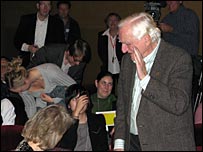 I met the man famed for presenting "the mother of all demos" Doug Engelbart, who was being honoured. Despite his health, he graciously spoke to everyone lining up to meet him, pump his fist and get their photo taken with him. And all of this done with an incredible modesty and slight incredulity no doubt.
Just as in 1968, here in 2008 there was a standing ovation for him. While 40 years ago he probably felt relieved that everything had gone better than according to plan, this time round emotion got the better and he had to wipe away a tear or two.
There was also Bill English who invented the computer mouse along with Doug and, while holding the very first one he built, simply described it as "just a tool." His wife Roberta accompanied him to what seemed almost like a reunion of the group that helped create the first collaborative computing system.
Jeff Rulifson who is now the director of VLSI Research Group at Sun Microsystems told me about long working hours, dinner at one in the morning in a Menlo Park burger and beer joint and hanging out at his Stanford University digs drinking sherry with Doug. He also recalled a rather heated argument his wife had with Doug over the idea of using a computer to write a shopping list. "Why would you want to do that? It's useless" Jeff quoted her as having said.
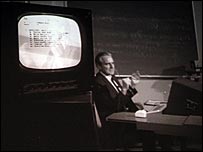 As Doug was demonstrating the technology in San Francisco, 30 miles away in Menlo Park was one of his software engineers Bill Paxton. Today he remembered how Doug was "a voice crying in the wilderness."
The man largely credited with helping that "voice" get heard was Bob Taylor who basically greenlighted the money to pay for this project and many others.
Journalist John Markoff of the New York Times called him the "true father of the internet."
The ideas of Mr Taylor along with J. C. R. Licklidder, or Lick as he was known, led to the creation of ARPANET and later the modern internet.
At the 40th celebration he told story after story about the good old days and of the one when a "suit" came from Washington to ask the pertinent question "I want to talk about Doug - Why are you funding this guy?"
And the rest they say is history. Albeit it a history that has not been fully realised as many of these men maintain, including Doug's daughter Christina who runs the Engelbart Institute and told me "There has been such an explosion of technology but it really hasn't reached the level of potential Dad envisioned actually in the early 1960s."
What struck me throughout the day of celebrations, the archive on display and hearing these men talk about that seminal time was the cameraderie and collegiate spirit that prevailed. Everyone wanted to share. Profit was not the motivation. There was a greater goal to be achieved.
Even today as this event looked back 40 years and acknowledged that what these men set out to achieve was extraordinary in terms of technological advances, they all remain so humble and unassuming.
I am not saying that some of that spirit doesn't exist today but there is the sense that back then it was oh so very different. Call it an age of innocence but I think the futurist Paul Saffo nailed it when he said the time back then was "a blank sheet of paper" and anything was possible.
And it was all done wearing shirts and ties. Yes even in 1968, there was not a pair of chinos or a polo shirt to be found. Ah very different days indeed.
The BBC is not responsible for the content of external internet sites
This is dot.life - a blog about technology from BBC News.
Rory Cellan-Jones is the BBC's technology correspondent.
Maggie Shiels is the BBC's tech reporter based in Silicon Valley.
Archive
« January 2010
| Sun | Mon | Tue | Wed | Thu | Fri | Sat |
|---|---|---|---|---|---|---|
| 1 | 2 | |||||
| 3 | 4 | 5 | 6 | 7 | 8 | 9 |
| 10 | 11 | 12 | 13 | 14 | 15 | 16 |
| 17 | 18 | 19 | 20 | 21 | 22 | 23 |
| 24 | 25 | 26 | 27 | 28 |
Being Discussed Now
- Logging out... and straight back in(3)
- Gadgets of the Noughties(20)
- Plastic Logic's long journey to Vegas(21)
- Sexting teens(17)
- Wikipedia on the wane?(49)
- 'Cooling-off' for mobile phones? Not on the High Street(37)
- 2009 - the social year(36)
- Twitter, Iran and #uksnow(25)
- Broadband Britain - how far down the league?(55)
- Microsoft and Murdoch: Teaming up to bash Google?(34)
BBC Technology Headlines
- %28none%29
%28none%29 - %28none%29
%28none%29 - %28none%29
%28none%29
Visit the Technology index
Visit the BBC News website
Rory's TV/Radio reports
- Residents block Google car
Broadcast: 3 April 2009 - New adverts to tackle film piracy
Broadcast: 2 April 2009 - Call to scrap 'illegal databases'
Broadcast: 23 March 2009 - Female robot takes to the catwalk
Broadcast: 16 March 2009 - Super-charged battery breakthrough
Broadcast: 12 March 2009

- News Editors
- Sport Editors
- Journalism Labs
- BBC Internet Blog
- Radio 4 Blog
- Peston's Picks
- Nick Robinson's Newslog
- Stephanomics
- Mark Easton's UK
- Mark Mardell's America
- Nick Bryant's Australia
- Andrew Harding on Africa
- Gavin Hewitt's Europe
- Soutik Biswas' India
- dot.Rory
- Science: Jonathan Amos
- Richard Black on environment
- Today: Tom Feilden
- Fergus Walsh's medical files
- Newsnight: Paul Mason
- Newsnight: Mark Urban
- Torin Douglas
- Will Gompertz's arts
- Phil Coomes on photojournalism
- Magazine Monitor
- Mark D'Arcy in Westminster
- NI: Mark Devenport
- Scotland: Brian Taylor
- Scotland: Douglas Fraser
- Wales: Betsan Powys
- Martin Rosenbaum on FOI
- 5 Live Breakfast
- Newsnight
- PM programme (iPM)
- World Tonight: Robin Lustig
