


Wikipedia is censored
- 8 Dec 08, 09:29 GMT
Is the internet censored in the UK? Well, no, most of us would say - you can get to any site you want, as long as it isn't breaking the law - and even then, the authorities are unlikely to intervene.
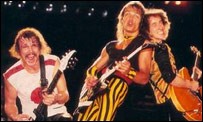 But now customers of several big internet service providers are finding that they cannot access one page of a website. And it's not just any website - it's Wikipedia. The page that they cannot view is about a relatively obscure 70s heavy metal band, Scorpions, and it has been blocked because it includes an image of a controversial album cover. That cover shows a naked child, and even back in the 70s it proved too distasteful for many, and was withdrawn in a number of countries.
Now the Internet Watch Foundation - which has been Britain's leading online child abuse watchdog for the past 12 years - has put that Wikipedia page on its banned list. The result is that those internet service providers which are members of IWF have blocked their users from accessing that page.
A host of Wikipedians is on the warpath, suggesting that this is censorship by a self-appointed body which has no right to decide what we can look at on the web. I caught up with one of them, David Gerard. He acts as a spokesman for Wikipedia volunteers in the UK - though he is not employed by the Wikimedia Foundation, the online encyclopaedia's governing body (which has issued a press release). I asked him why he was so angry when most people would probably support any body which is trying to stamp out child abuse images on the web.
First of all, he stressed that he was not saying that he found the image in question acceptable. "I personally find it distasteful," he said. "But is it illegal?"
He went on to explain that there were two reasons that Wikipedians felt angry: firstly, that IWF could decide on its own that something was illegal; secondly, that its actions had blocked the text on the page as well as the image itself.
Mr Gerard claimed that there was no evidence that any court had ruled that the image was illegal - indeed it was in books that were stored in libraries. "Are the police going to go into those libraries and rip out the offending page?" he asked.
He went on to explain that it would have been relatively simple for the IWF to block the image but to leave the accompanying text alone. But he said that nobody had contacted anyone from Wikipedia - the watchdog had just gone ahead and laid down the law.
This issue is the subject of feverish debate on Wikipedia mailing lists and forums, and there is already a Facebook group to call for a boycott of ISPs which censor Wikipedia. Some are suggesting that this makes the UK little better than China in terms of internet censorship, though other Wikipedia users are not quite so sure that this is the right issue for an anti-censorship campaign.
So what does the Internet Watch Foundation have to say? A spokeswoman explained that the image had been referred to them by a member of the public. After examination - and consultation with the police - it was assessed as "a potentially illegal image" and put on the banned list that is given to internet service providers, who then block the URL. She went on to explain that this is a routine procedure which is used for all sorts of images that are reported to the IWF - it just so happened that this involved one of the internet's most famous sites.
I've also spoken to one of the ISPs which is blocking the Wikipedia page. A spokesman made it clear that the process was automatic - the ISP just takes the list and implements its own blocking procedures. He said that his company would certainly not be criticising the watchdog: "The Internet Watch Foundation has a tough job and an important role in protecting our children. We just have to support them - we can't pick and choose."
So: a fascinating case which sheds light on the debate about freedom of speech on the internet. On the one side, a body which has been fighting to free the web of child abuse images, waging a war which has the support of the vast majority of web users. On the other, the digital libertarians who believe that once we let a group of unelected regulators decide what is fit for us to see on the web, we are on the road to Orwellian thought control. Who is in the right? You decide.
The BBC is not responsible for the content of external internet sites
This is dot.life - a blog about technology from BBC News.
Rory Cellan-Jones is the BBC's technology correspondent.
Maggie Shiels is the BBC's tech reporter based in Silicon Valley.
Archive
« January 2010
| Sun | Mon | Tue | Wed | Thu | Fri | Sat |
|---|---|---|---|---|---|---|
| 1 | 2 | |||||
| 3 | 4 | 5 | 6 | 7 | 8 | 9 |
| 10 | 11 | 12 | 13 | 14 | 15 | 16 |
| 17 | 18 | 19 | 20 | 21 | 22 | 23 |
| 24 | 25 | 26 | 27 | 28 |
Being Discussed Now
- Logging out... and straight back in(3)
- Gadgets of the Noughties(20)
- Plastic Logic's long journey to Vegas(21)
- Sexting teens(17)
- Wikipedia on the wane?(49)
- 'Cooling-off' for mobile phones? Not on the High Street(37)
- 2009 - the social year(36)
- Twitter, Iran and #uksnow(25)
- Broadband Britain - how far down the league?(55)
- Microsoft and Murdoch: Teaming up to bash Google?(34)
BBC Technology Headlines
- %28none%29
%28none%29 - %28none%29
%28none%29 - %28none%29
%28none%29
Visit the Technology index
Visit the BBC News website
Rory's TV/Radio reports
- Residents block Google car
Broadcast: 3 April 2009 - New adverts to tackle film piracy
Broadcast: 2 April 2009 - Call to scrap 'illegal databases'
Broadcast: 23 March 2009 - Female robot takes to the catwalk
Broadcast: 16 March 2009 - Super-charged battery breakthrough
Broadcast: 12 March 2009

- News Editors
- Sport Editors
- Journalism Labs
- BBC Internet Blog
- Radio 4 Blog
- Peston's Picks
- Nick Robinson's Newslog
- Stephanomics
- Mark Easton's UK
- Mark Mardell's America
- Nick Bryant's Australia
- Andrew Harding on Africa
- Gavin Hewitt's Europe
- Soutik Biswas' India
- dot.Rory
- Science: Jonathan Amos
- Richard Black on environment
- Today: Tom Feilden
- Fergus Walsh's medical files
- Newsnight: Paul Mason
- Newsnight: Mark Urban
- Torin Douglas
- Will Gompertz's arts
- Phil Coomes on photojournalism
- Magazine Monitor
- Mark D'Arcy in Westminster
- NI: Mark Devenport
- Scotland: Brian Taylor
- Scotland: Douglas Fraser
- Wales: Betsan Powys
- Martin Rosenbaum on FOI
- 5 Live Breakfast
- Newsnight
- PM programme (iPM)
- World Tonight: Robin Lustig
