


MySpace the moneymaker
- 15 Oct 08, 14:48 GMT
They're the forgotten company of social networking - less fashionable than Facebook, less techie than Twitter, less useful than YouTube. But maybe MySpace is the only one of them that's making money. That at least was the message I took away from a meeting at Stockholm's European Technology Round Table with Travis Katz, who runs all the network's activities outside the United States.
 He's quite a contrast with Mark Zuckerberg of Facebook who I met last week - and that tells you something about the difference between the cultures of the two businesses. Mr Zuckerberg seems like any young developer you might meet in college or at a Silicon Valley start-up. He's shy, focussed on coding rather than commerce, and passionate about making his product better - though he finds that passion hard to communicate.
Travis Katz is older, more at ease with a crowd - I met him as he got off the stage after a pretty fluent half-hour chat in front of the banking and technology audience of ETRE. He studied politics at college and was amused by the spat that we'd just seen on stage between market fundamentalist Tim Draper and democrat donor Rob Glaser, without ever revealing his own politics. He is just as passionate about MySpace as Zuckerberg is about Facebook - but far more comfortable about talking about the business as well as the user experience.
In order to see this content you need to have both Javascript enabled and Flash installed. Visit BBC Webwise for full instructions. If you're reading via RSS, you'll need to visit the blog to access this content.
MySpace has of course been in the warm embrace of the Murdoch empire since 2005, and Mr Katz indicated that this wasn't a place where you just got on with growing the audience size and let the bottom line go hang.
He was keen to point out that MySpace had been profitable from the start, and had achieved revenues of $850m last year: "That's phenomenal for a company that's only five years old...it took Google and Yahoo eight years to get that far...we're monetising faster than almost any company that's come before us on the internet."
I wondered whether, in the harder times we're now facing, there was going to be room for as many Web 2.0 companies as there are out there right now. Here's what Travis Katz had to say - in an audio interview rather than the video version you'll see above:
"Some of these guys are going to fail. If you haven't figured out your business model by now and you're heading into these tough economic times I think you should be worried. If you don't have money coming in, you're going to burn through your cash."
Just about all of these social networks and other Web 2.0 companies have actually figured out that their business model depends on advertising - the trouble is they haven't really convinced their audiences of that. And while online ad spending continues to grow it's bound to flatten out if we have a serious recession.
So MySpace may look pretty annoying to the jaundiced eyes of an older networker - but, with a core audience that has grown used to seeing adverts it may have a better chance of coming out the other side of a downturn than some of its rivals.
Hope and fear in Stockholm
- 15 Oct 08, 10:30 GMT
Here's one new company that wants to offer a whole operating system in the internet "cloud", then there's another with a system to help you manage all of your online passwords - oh and here's someone who has found a clever new way to navigate web pages.
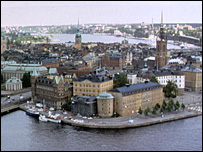 They're all trying to impress a room full of investment bankers and venture capitalists. This is ETRE, the European Technology Round Table, holding its nineteenth annual event which tries to put tech companies together with the financiers who might fund them.
But the gathering at a Stockholm hotel could not come at a worse time. There has not been a single new tech company launched on the stock markets in New York or London this year, and everyone in the world of finance is in a state of shock, reeling from events which have made them question all the accepted wisdom of the last twenty years.
The crowd gathered at a Stockholm hotel from across Europe and from the United States seemed divided, rather like passengers on the Titanic, between desperation and hope. You could have excused the European crowd for being confused because the event opened with an extraordinary series of speeches from American speakers with very different views of the world.
If you believe Tim Draper, CEO of the venture firm Draper, Fisher, Jurvetson, our present predicament is all the fault of the "the government, the lawmakers, and the media." Mr Draper, whose impressive track record includes backing firms like Skype, Hotmail and Baidu, told the audience that there had been a century long battle between communism and freedom, suggesting that the current round of government intervention was a victory for communism, but went on to proclaim huge optimism about the future of markets and technology.
He also revealed that he had sent his DNA into space in the hope that aliens would find it and "grow entrepreneurship forever", and tried to lead the crowd in a song he'd written called "Endeavour Forever".
Rob Glaser, the CEO of Real Networks, then took to the stage to say this was "one of the most insane weeks ever to preach market fundamentalism," and insisted that recent events showed that some government regulation was necessary.
While he took a much more gloomy view of the market and the prospects for start-ups than Mr Fisher, he still believed that well-funded companies could continue to thrive - though firms which had entered the downturn with good technology but little cash might struggle.
Next, a series of hopeful technology entrepreneurs got their chance to shine in a session called "Show Me The Money". In a crueller version of Dragons' Den, they had to give a two minute pitch to a panel of investors explaining why they were worth backing.
Most got the thumbs down, with the panel chairman Alex Vieux of Red Herring being particularly savage. He interrupted a nervous Swede to tell him that he'd already fouled up by going over his allotted time, and then told a woman who'd joined with her husband to start a business that "husband and wife businesses never work. No investor wants to be the third in the bedroom."
You might have thought the start-ups would be shell-shocked but as they gathered for an evening reception in Stockholm's maritime museum, many told me they were still hopeful that the money they had spent to be at this event would not be wasted. Like all entrepreneurs, they appeared convinced that the merit of their ideas would shine out amid the gloom. Meanwhile in another corner financiers talked of the letter sent out last week by Sequoia - one of Silicon Valley's leading venture firms - warning its early-stage firms to bunker down, cut costs, and try to sit out the storm.
Over all of them loomed the magnificent centrepiece of the museum, a giant warship built for the King of Sweden in the 17th Century. It was more expensive and more advanced than any ship of its era - but sank in a hundred feet of water in Stockholm harbour a few minutes after it was launched, and was only recovered from the water in the 1950s, almost perfectly preserved. In other words, a technological triumph which turned into a disaster...make of that what you will.
The BBC is not responsible for the content of external internet sites
This is dot.life - a blog about technology from BBC News.
Rory Cellan-Jones is the BBC's technology correspondent.
Maggie Shiels is the BBC's tech reporter based in Silicon Valley.
Archive
« January 2010
| Sun | Mon | Tue | Wed | Thu | Fri | Sat |
|---|---|---|---|---|---|---|
| 1 | 2 | |||||
| 3 | 4 | 5 | 6 | 7 | 8 | 9 |
| 10 | 11 | 12 | 13 | 14 | 15 | 16 |
| 17 | 18 | 19 | 20 | 21 | 22 | 23 |
| 24 | 25 | 26 | 27 | 28 |
Being Discussed Now
- Logging out... and straight back in(3)
- Gadgets of the Noughties(20)
- Plastic Logic's long journey to Vegas(21)
- Sexting teens(17)
- Wikipedia on the wane?(49)
- 'Cooling-off' for mobile phones? Not on the High Street(37)
- 2009 - the social year(36)
- Twitter, Iran and #uksnow(25)
- Broadband Britain - how far down the league?(55)
- Microsoft and Murdoch: Teaming up to bash Google?(34)
BBC Technology Headlines
- %28none%29
%28none%29 - %28none%29
%28none%29 - %28none%29
%28none%29
Visit the Technology index
Visit the BBC News website
Rory's TV/Radio reports
- Residents block Google car
Broadcast: 3 April 2009 - New adverts to tackle film piracy
Broadcast: 2 April 2009 - Call to scrap 'illegal databases'
Broadcast: 23 March 2009 - Female robot takes to the catwalk
Broadcast: 16 March 2009 - Super-charged battery breakthrough
Broadcast: 12 March 2009

- News Editors
- Sport Editors
- Journalism Labs
- BBC Internet Blog
- Radio 4 Blog
- Peston's Picks
- Nick Robinson's Newslog
- Stephanomics
- Mark Easton's UK
- Mark Mardell's America
- Nick Bryant's Australia
- Andrew Harding on Africa
- Gavin Hewitt's Europe
- Soutik Biswas' India
- dot.Rory
- Science: Jonathan Amos
- Richard Black on environment
- Today: Tom Feilden
- Fergus Walsh's medical files
- Newsnight: Paul Mason
- Newsnight: Mark Urban
- Torin Douglas
- Will Gompertz's arts
- Phil Coomes on photojournalism
- Magazine Monitor
- Mark D'Arcy in Westminster
- NI: Mark Devenport
- Scotland: Brian Taylor
- Scotland: Douglas Fraser
- Wales: Betsan Powys
- Martin Rosenbaum on FOI
- 5 Live Breakfast
- Newsnight
- PM programme (iPM)
- World Tonight: Robin Lustig
