


Broadband poverty - a 1% problem?
- 18 Jul 08, 09:10 GMT
This week saw BT's announcement of its plan to invest £1.5bn in fibre-based broadband - a move I thought was pretty significant. But as soon as I'd written about it I received an e-mail from someone who wasn't impressed at all.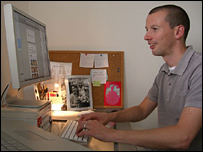 "There is a significant number of people like me who live and run businesses in rural communities that can still not receive broadband at all," wrote Adrian Linney. "We are a small minority of households/business for sure, but we are living in digital poverty whilst those who live in or near cities have their greed for speed met ultimately at our expense." Mr Linney lives in Herefordshire, not a particularly remote location.
I was intrigued, especially as I'd heard from other people in similar circumstances who could not understand why the broadband revolution had not reached their doorsteps. So I called Adrian Linney to find out why he couldn't get connected. The answer was that he was seven miles from the nearest exchange and a BT engineer who came and tested the line told him that was too far away to get broadband by the normal ADSL route. As a graphic designer working from home he needs to be online, so he's had to resort to satellite broadband - at £70 a month for a 512Kbps connection.
So how many people are in this situation? My next call was to the telecoms regulator Ofcom. "The exact scale of the problem is difficult to quantify," came the reply. But they pointed me towards the statistic that is often trotted out - that over 99% of the population is connected to a broadband enabled exchange. So, if you believe that, less than 1% of the UK population is living in "broadband poverty".
But how robust are those figures is not clear. Adrian Linney for instance is connected to a broadband enabled exchange - indeed when I popped his number into BT's speed check site it came back with this message:
"We've just tested your line and can confirm your line supports the UK's most complete broadband package, BT Total Broadband. We estimate your maximum download speed to be 6.0 Mbps". But of course the engineer told Mr Linney that his maximum speed would be - well, around zero.
There do seem to be quite a few of these broadband "not spots", places that aren't up some mountain or on a remote island but just a few too many miles from the nearest exchange, and there may well be more people in them than the 1% of the population suggested by Ofcom.
Now BT says with some justification that it is not a social service but a company owned by shareholders who demand a return on their investment, so it can't be expected to spend a fortune bringing broadband to every last home. Ofcom says it is encouraging local development bodies to help fill any gaps in broadband provision.
But Adrian Linney wonders whether it will be sustainable, in a few years time when much of the country is being offered speeds of 20, 40, or even 100Mbps, to leave people like him out of the broadband age.

The sun sets on E3
- 18 Jul 08, 06:48 GMT
I wasn't exactly the last to leave the LA Convention Center but I was certainly among the final few to be ushered out politely by security staff.
After four days, three major press conferences, 14 interviews and enough Snapple to stun a cow my E3 draws to a close.
If you haven't seen it already, we have a special section devoted to E3. There you'll find lots of lovely video from our time in LA.
We've tried to do more video this year - which for me meant operating a camera and doing some video editing. So I take responsibility for all the video diaries. Here's my final diary.
My colleague Andrew Webb produced all the good stuff. Can I point you in the direction of the sequence about the Championship Gaming Series, the Into The Pixel exhibition, and the show floor tour.
Although E3 is a fraction of the size it was, in many ways it means more work. It's easier to meet more people, play more games, which means producing more output.
The E3 of old was so crowded, so impossibly frenetic that it was almost impossible to get work done.
There are plenty of things I didn't get a chance to see, not least The Who playing at EA's Rockband 2 party at The Orpheum in Los Angeles. My colleague Iain Mackenzie saw them and said they were awesome; he's from Radio 1 so I trust his judgement.
The best part of the show is always the snatches of conversations you have with developers, often after the camera has stopped rolling.
Developers like Todd (Bethesda) Howard and Eric (Crystal Dynamics) Lindstrom were terrific conversationalists. All of it was off the record, but believe me these guys are very smart.
In many ways the new smaller, more dignified E3 represents an industry that is finally growing up.
One of the reasons that E3 used to be such a carnival of light and sound was because the industry was trying so desperately hard to impress.
One of the PRs I spoke to this week said it was about convincing lifestyle journalists that the games industry was credible: "The games industry does Hollywood."
Some people have emailed me to ask why Technology is covering the games industry and not Entertainment. It's a valid question.
It's because, by and large, the BBC like many other mainstream media organisations does not really see video games as part of the entertainment industry.
It's an attitude that is changing slowly, but rather than see no coverage at all on the BBC, I'd rather do some under the Technology umbrella.
I even managed to get a radio package about E3 on the Today programme on Radio 4.
And if that's not progress, then I don't know what is.
The BBC is not responsible for the content of external internet sites
This is dot.life - a blog about technology from BBC News.
Rory Cellan-Jones is the BBC's technology correspondent.
Maggie Shiels is the BBC's tech reporter based in Silicon Valley.
Archive
« January 2010
| Sun | Mon | Tue | Wed | Thu | Fri | Sat |
|---|---|---|---|---|---|---|
| 1 | 2 | |||||
| 3 | 4 | 5 | 6 | 7 | 8 | 9 |
| 10 | 11 | 12 | 13 | 14 | 15 | 16 |
| 17 | 18 | 19 | 20 | 21 | 22 | 23 |
| 24 | 25 | 26 | 27 | 28 |
Being Discussed Now
- Logging out... and straight back in(3)
- Gadgets of the Noughties(20)
- Plastic Logic's long journey to Vegas(21)
- Sexting teens(17)
- Wikipedia on the wane?(49)
- 'Cooling-off' for mobile phones? Not on the High Street(37)
- 2009 - the social year(36)
- Twitter, Iran and #uksnow(25)
- Broadband Britain - how far down the league?(55)
- Microsoft and Murdoch: Teaming up to bash Google?(34)
BBC Technology Headlines
- %28none%29
%28none%29 - %28none%29
%28none%29 - %28none%29
%28none%29
Visit the Technology index
Visit the BBC News website
Rory's TV/Radio reports
- Residents block Google car
Broadcast: 3 April 2009 - New adverts to tackle film piracy
Broadcast: 2 April 2009 - Call to scrap 'illegal databases'
Broadcast: 23 March 2009 - Female robot takes to the catwalk
Broadcast: 16 March 2009 - Super-charged battery breakthrough
Broadcast: 12 March 2009

- News Editors
- Sport Editors
- Journalism Labs
- BBC Internet Blog
- Radio 4 Blog
- Peston's Picks
- Nick Robinson's Newslog
- Stephanomics
- Mark Easton's UK
- Mark Mardell's America
- Nick Bryant's Australia
- Andrew Harding on Africa
- Gavin Hewitt's Europe
- Soutik Biswas' India
- dot.Rory
- Science: Jonathan Amos
- Richard Black on environment
- Today: Tom Feilden
- Fergus Walsh's medical files
- Newsnight: Paul Mason
- Newsnight: Mark Urban
- Torin Douglas
- Will Gompertz's arts
- Phil Coomes on photojournalism
- Magazine Monitor
- Mark D'Arcy in Westminster
- NI: Mark Devenport
- Scotland: Brian Taylor
- Scotland: Douglas Fraser
- Wales: Betsan Powys
- Martin Rosenbaum on FOI
- 5 Live Breakfast
- Newsnight
- PM programme (iPM)
- World Tonight: Robin Lustig
