


Phone apps - open or closed?
- 10 Jul 08, 16:34 GMT
We're trying to ignore the hullabaloo over the 3G iPhone (is a 3G phone really that new?) but the launch of Apple's applications store is of far more interest. Firstly because it's the first real mass-market attempt to sell mobile users on the idea of downloaded software, and secondly because of the way the whole system has been locked down by Apple, to the dismay of some smaller developers. That's a real contrast with the way some of Apple's rivals in the mobile software world are operating.
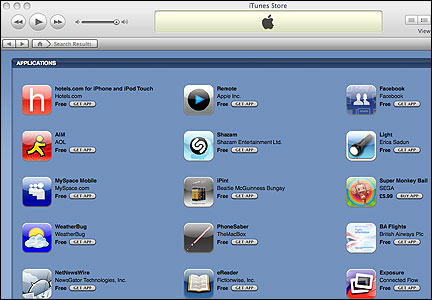 By lunchtime on Thursday the iPhone apps store was up and running - though rather hard to find on iTunes.
I browsed through hundreds of free apps, from iPint, which makes your iPhone look like a pint of lager, to social networks like Facebook and MySpace, to a British Airways application which gives you a live departures board - but may not tell you where your lost luggage has gone. There is an Apple application which turns your iPhone or iPod into a remote which can control your iTunes from anywhere over your wi-fi network - and another developer will turn your phone into a light sabre.
The paid-for applications seemed thinner on the ground - they included maps of New York, photo sharing services, and a number of games. The most expensive appeared to be Netterman's Anatomy Flash Cards for £23.99, so if your doctor gets out his iPhone during a consultation you'll know what's happening.
"A bunch of stuff that I never needed before, and probably don't need now," was the cynical response from one colleague when I read out this list. He may be right about the paid-for applications - but I think the free stuff will fly off the virtual shelf. For many people it will be the first time they've been introduced to the idea that you can customise your phone with new software.
Of course you can already do that on plenty of other phones - I've put several free mobile video applications on a Nokia phone - but I'd guess the vast majority of users have never caught on to that.
So this is a game-changer - but Apple has written some very rigid rules. It controls access to the Apps Store and to the iPhone. "It's very locked-down" one small developer told me, contrasting Apple's approach to Google's upcoming Android platform and even to Windows Mobile.
Joe Richards has been trying to get his security application iRedhanded (it sends out annoying noises to anyone who steals your phone and wipes personal data) onto the applications store. He says big firms have been welcomed in - but for smaller players like him "it's like waiting outside a nightclub with the bouncer promising you'll be let in sooner or later."
He believes that the army of small and innovative developers who could make the real difference are being alienated: "There's a serious danger that they hack off the smaller developers and they go off to Android." Android is not the only threat. Symbian, now wholly owned by Nokia and going open-source, is by far the biggest player in this industry.
There is definitely a benefit to Apple's approach. After all, a bit of quality control will be welcomed by consumers - remember all those useless and annoying Facebook applications which appeared after it threw open its doors to any developer big or small?
But if Symbian, Google Android and Windows Mobile have any sense they will be opening their own applications supermarkets - and finding out whose approach, open or closed, proves most attractive to mobile users.
UPDATE:
Okay, to those who think I've committed some terrible faux-pas by even daring to write about the iPhone apps store without spending a couple of weeks with a cold flannel on my head, let me make a few things clear:
The 3g iPhone will be a big successes - the queues at my local shopping centre at an O2 and two Carphone Warehouse stores at 0900 tell me that, though there was much grumbling in the line when the message arrived "the computers are down".
The App store is already doing a lot of business and has some really good stuff - as I said above it is a "game-changer". But don't think the likes of Symbian, Windows Mobile and Google are going to let the market be taken away from them without a fight
And, finally, if a BBC blog waited for a few weeks to reflect a story that much of the tech world is talking about, would that be a sensible strategy?

RIP the Fake Steve Jobs
- 10 Jul 08, 07:13 GMT
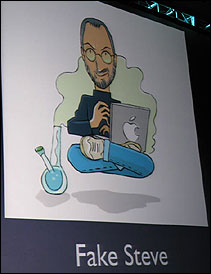 It is with deep regret that I write about the passing of the Fake Steve Jobs.
The character, who allegedly had more than a passing resemblance to the Apple chief, was devised by Dan Lyons. Dan was the person who gave me some very sage advice on starting my first blog, which was "Don't do it, it's like a monkey on your back."
Well, it seems Dan is ditching the monkey that has been on his back for the last couple of years, despite the fact it resulted in a certain amount of notoriety, a modicum of fame and quite a bit of success. Oh and let's not forget the mini witch-hunt that was carried out to unmask the Fake Steve and find out who was behind the creation that captivated the technology world.
Eventually the blogosphere discovered that Forbes editor Dan Lyons conjured up the secret diary of Steve Jobs as a way to stay relevant and in a job. No more worries on that score, because the blog has propelled Dan into a new job with Newsweek.
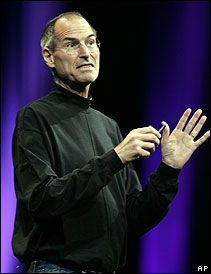 Apparently Apple complained about their new signing. Dan did reveal that he understood Mr Jobs was not best pleased with the parody that portrayed him as egocentric and autocratic.
As well as moving onto pastures new, the real Dan Lyons will get the chance to shine through with a column under his own name. So it was those developments on the horizon that prompted the affable Dan to let the Fake Steve put down his weed and hippy mantras and call it a day.
He also admitted to getting a little tired of the Fake Steve and even when he thought about doing a similar diary with another character, it just wasn't convincing.
"I tried transitioning to other voices, like Jerry Yang, but it just didn't work," said Mr Lyons.
"It seems clear that people reading the blog wanted to read Fake Steve or nothing."
In his final blog, the Fake Steve writes "I'm sorry that the blog is fizzling out. I know you'll miss FSJ. So will I. But rest assured, Fake Steve is not really going away. He's just taken on a new form. As Jimi Hendrix once said, 'If I don't see you no more in this world, I'll meet you on the next one, but don't be late'."
But if you just can't face the future without the musings of the Fake Steve, then you won't have too long to wait because a book of his bon mots is out very soon and Dan is also working on a script to put his creation on the silver screen.
Namaste to all. Much love. Peace out.
The final poignant words of one Fake Steve Jobs. What will life be like without him?
The BBC is not responsible for the content of external internet sites
This is dot.life - a blog about technology from BBC News.
Rory Cellan-Jones is the BBC's technology correspondent.
Maggie Shiels is the BBC's tech reporter based in Silicon Valley.
Archive
« January 2010
| Sun | Mon | Tue | Wed | Thu | Fri | Sat |
|---|---|---|---|---|---|---|
| 1 | 2 | |||||
| 3 | 4 | 5 | 6 | 7 | 8 | 9 |
| 10 | 11 | 12 | 13 | 14 | 15 | 16 |
| 17 | 18 | 19 | 20 | 21 | 22 | 23 |
| 24 | 25 | 26 | 27 | 28 |
Being Discussed Now
- Logging out... and straight back in(3)
- Gadgets of the Noughties(20)
- Plastic Logic's long journey to Vegas(21)
- Sexting teens(17)
- Wikipedia on the wane?(49)
- 'Cooling-off' for mobile phones? Not on the High Street(37)
- 2009 - the social year(36)
- Twitter, Iran and #uksnow(25)
- Broadband Britain - how far down the league?(55)
- Microsoft and Murdoch: Teaming up to bash Google?(34)
BBC Technology Headlines
- %28none%29
%28none%29 - %28none%29
%28none%29 - %28none%29
%28none%29
Visit the Technology index
Visit the BBC News website
Rory's TV/Radio reports
- Residents block Google car
Broadcast: 3 April 2009 - New adverts to tackle film piracy
Broadcast: 2 April 2009 - Call to scrap 'illegal databases'
Broadcast: 23 March 2009 - Female robot takes to the catwalk
Broadcast: 16 March 2009 - Super-charged battery breakthrough
Broadcast: 12 March 2009

- News Editors
- Sport Editors
- Journalism Labs
- BBC Internet Blog
- Radio 4 Blog
- Peston's Picks
- Nick Robinson's Newslog
- Stephanomics
- Mark Easton's UK
- Mark Mardell's America
- Nick Bryant's Australia
- Andrew Harding on Africa
- Gavin Hewitt's Europe
- Soutik Biswas' India
- dot.Rory
- Science: Jonathan Amos
- Richard Black on environment
- Today: Tom Feilden
- Fergus Walsh's medical files
- Newsnight: Paul Mason
- Newsnight: Mark Urban
- Torin Douglas
- Will Gompertz's arts
- Phil Coomes on photojournalism
- Magazine Monitor
- Mark D'Arcy in Westminster
- NI: Mark Devenport
- Scotland: Brian Taylor
- Scotland: Douglas Fraser
- Wales: Betsan Powys
- Martin Rosenbaum on FOI
- 5 Live Breakfast
- Newsnight
- PM programme (iPM)
- World Tonight: Robin Lustig
