


Watching you, watching YouTube
- 4 Jul 08, 11:03 GMT
I can't be the only one who's been thinking rather nervously about exactly what they've been looking at on YouTube over the years now that Viacom's lawyers are about to get their hands on our viewing habits.
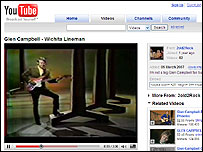 Luckily, I don't think there's much that is too embarrassing in my case, apart from a run of dodgy videos of even dodgier 1970s bands.
But for everyone who leaves a data trail across the internet this is a wake-up call. When you do just about anything online - from a Google search to a Facebook message to a spot of file-sharing - you are leaving traces of yourself that you might prefer to stay private.
For all the talk of a surveillance society, the analogue world can still be a more private place - if I choose to watch conventional television, stick a friend's copied CD in the player, or post a letter, nobody is likely to know.
Of course, there's no real need to worry about your digital footprint. The big corporations that hold our data on their servers have promised us all that it is safe in their hands. Not a chance that Tesco will hand over your Clubcard data to outsiders for marketing purposes, or that your ISP will let anyone else know that you've been uploading your music collection onto Limewire. No way will Ebay reveal that you spend most of your time at work just checking out whether you're still the highest bidder for that (fake) Rolex.
But the YouTube case seems to show that, despite those promises, we have no real control over our data once it is lodged on a corporate server. Every detail of my viewing activities over the years - the times I've watched videos in the office, the clips of colleagues making idiots of themselves, the unauthorised clip of goals from a Premier League game - is contained in those YouTube logs.
All to be handed over to Viacom's lawyers on a few "over-the-shelf four-terabyte hard drives", according to the New York judge who made the ruling. I may protest that I am a British citizen and that the judge has no business giving some foreign company a window on my world. No use - my data is in California, and it belongs to Google, not me.
The other troubling aspect about this case was that it was only the blogs that seemed to understand the significance of the ruling when it emerged on Wednesday night. Much of the mainstream media ignored it at first, seeming to regard it as a victory for Google, because the judge said the search firm didn't have to reveal its source code.
Great news for Google - but the other part of the ruling was deeply worrying for its users, as the technology bloggers were quick to spot. Indeed Google's statement began by welcoming its victory on the code issue, before moving on to the little problem of the YouTube logs.
Now I've never worried too much about the threat to my privacy. I'm relaxed about appearing on CCTV, happy enough for my data to be used for marketing purposes, as long as I've ticked a box, and have never really cared that Google knows about every search I've done for the last 18 months. But suddenly I'm feeling a little less confident. How about you?

Google, privacy and Street View
- 4 Jul 08, 08:50 GMT
As soon as Google launched Street View, its innovative photo-mapping tool, people began complaining that their privacy had been compromised.
From the man walking out of a sex shop, to the sun-bathing girls - had Google compromised their privacy by taking photographs of streets that also captured people going about their daily lives?
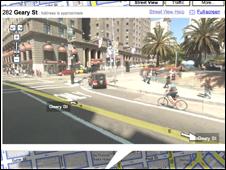 The tool launches in the UK soon and the cars which drive up and down streets taking snaps have been spotted on the streets of London.
But will Street View in the UK fall foul of data protection laws? Simon Davies, of Privacy International, believes that Google needs to get permission from people who are snapped on Street View, because the tool is being used for commercial ends.
You can read more here.
Google has taken a lot of flak recently over its privacy policies, with warnings from European Information Commissioners and complaints its privacy policy is hidden.
Google has taken at least one step to address concerns; placing a link to its privacy policy on its homepage. Is this enough of a step?
Simon Davies has written to Google outlining his concerns. It makes for interesting reading.
So take a look for yourself. Here it is:
2nd July 2008
Jane Horvath,
Senior privacy counsel,
Google
Mountainview CA
Dear Jane,
Recent media reports in Europe have mentioned that Google has begun deployment of its StreetView system in the UK and elsewhere in the EU. You may be aware that Privacy International has stated, both privately to Google legal staff and to the media, that we are concerned about a number of potential violations of national law that this technology may create.
In response, Google has informed the media that it will institute "face blurring" technology to ensure legal compliance. However, when we requested information from Google six weeks ago about the specifications for this technology your colleagues admitted that there were problems with it at an engineering level.
We are concerned that claims of protection are being made that may not be possible to institute. I am writing to request full disclosure of the technology specifications for the promised face and number plate blurring system so that the public can be assured that Google has taken every step necessary to satisfy not just legal requirements, but that it is also fulfilling its stated commitments.
We have in the past raised concerns directly with Google that such claims have historically failed to materialise. I recall the promise made by Google to the FTC during the Doubleclick acquisition that "crumbling cookies" would be developed. We have seen no evidence that this technology has been deployed. In response to concerns expressed at the time of our 2007 Internet privacy rankings, Google also promised a "privacy dashboard" to help consumers understand the functionality of their user settings. This technology has not appeared.
You will know that we have often complained that Google performs poorly on the issue of transparency. I believe this is one occasion where disclosure is crucial. Public trust in Google will suffer if there is a perception that the company is manipulating the facts.
I ask that you respond with this technical information within seven days. I also ask that you inform us of the steps, if any, that you have taken to consult the public over the use of their images for what is, in effect, a commercial purpose.
If we do not receive a satisfactory answer within that period we will have no choice but to lodge a complaint with the UK Information Commissioner with a request that StreetView deployment be suspended pending a formal investigation.
Yours sincerely
Simon Davies
Director
Privacy International
The BBC is not responsible for the content of external internet sites
This is dot.life - a blog about technology from BBC News.
Rory Cellan-Jones is the BBC's technology correspondent.
Maggie Shiels is the BBC's tech reporter based in Silicon Valley.
Archive
« January 2010
| Sun | Mon | Tue | Wed | Thu | Fri | Sat |
|---|---|---|---|---|---|---|
| 1 | 2 | |||||
| 3 | 4 | 5 | 6 | 7 | 8 | 9 |
| 10 | 11 | 12 | 13 | 14 | 15 | 16 |
| 17 | 18 | 19 | 20 | 21 | 22 | 23 |
| 24 | 25 | 26 | 27 | 28 |
Being Discussed Now
- Logging out... and straight back in(3)
- Gadgets of the Noughties(20)
- Plastic Logic's long journey to Vegas(21)
- Sexting teens(17)
- Wikipedia on the wane?(49)
- 'Cooling-off' for mobile phones? Not on the High Street(37)
- 2009 - the social year(36)
- Twitter, Iran and #uksnow(25)
- Broadband Britain - how far down the league?(55)
- Microsoft and Murdoch: Teaming up to bash Google?(34)
BBC Technology Headlines
- %28none%29
%28none%29 - %28none%29
%28none%29 - %28none%29
%28none%29
Visit the Technology index
Visit the BBC News website
Rory's TV/Radio reports
- Residents block Google car
Broadcast: 3 April 2009 - New adverts to tackle film piracy
Broadcast: 2 April 2009 - Call to scrap 'illegal databases'
Broadcast: 23 March 2009 - Female robot takes to the catwalk
Broadcast: 16 March 2009 - Super-charged battery breakthrough
Broadcast: 12 March 2009

- News Editors
- Sport Editors
- Journalism Labs
- BBC Internet Blog
- Radio 4 Blog
- Peston's Picks
- Nick Robinson's Newslog
- Stephanomics
- Mark Easton's UK
- Mark Mardell's America
- Nick Bryant's Australia
- Andrew Harding on Africa
- Gavin Hewitt's Europe
- Soutik Biswas' India
- dot.Rory
- Science: Jonathan Amos
- Richard Black on environment
- Today: Tom Feilden
- Fergus Walsh's medical files
- Newsnight: Paul Mason
- Newsnight: Mark Urban
- Torin Douglas
- Will Gompertz's arts
- Phil Coomes on photojournalism
- Magazine Monitor
- Mark D'Arcy in Westminster
- NI: Mark Devenport
- Scotland: Brian Taylor
- Scotland: Douglas Fraser
- Wales: Betsan Powys
- Martin Rosenbaum on FOI
- 5 Live Breakfast
- Newsnight
- PM programme (iPM)
- World Tonight: Robin Lustig
