There are around 8.3 BILLION people on Earth - but we only live on about a third of the planet.

That’s because the other two-thirds is made up of our oceans. While we have been studying the sea for centuries, we still don’t know everything about them. Add in issues of climate change and pollution and the waters around us have become the source of many claims on socials.
It’s not always easy to tell if these claims are true or not. BBC Bitesize Other Side of the Story contacted the National Oceanography Centre in Southampton to find out which stories the experts there would like to set straight. Here are a selection.
CLAIM: The earth sea levels are not rising. FALSE
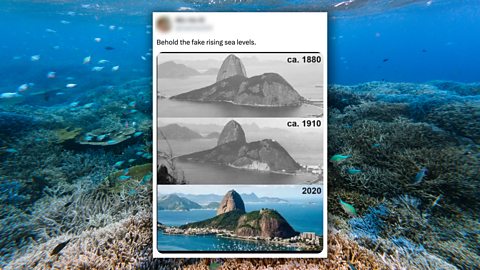
Dr Andrew Matthews is one of the scientists working at NOC and is an expert in tidal levels. He told Other Side of the Story how he is regularly shown sets of photos which show the same location in different decades where the water level doesn’t seem to have changed at all. These images are used by some as an argument that, despite climate change, sea levels are not rising.
This is not true, as Dr Matthews explained: “All of these places will have tides, depending where they are.
“It could be that these photos are taken at different times of day. It could be that an early photo has been taken at high tide and the recent one at a different stage of the tide. It’s just not appropriate evidence. It doesn’t really tell you anything without knowing what time of day they were taken.”
To measure the tide properly, Dr Matthews and his colleagues use something called a tide gauge. These record sea levels and was first introduced in the seas around the UK in 1953 to help with flood warnings. They record tides at 42 different places around the coast. This type of research has helped the NOC find that sea levels around the world have risen by just over 10cm since 1993.
It’s important to get information about climate change and rising sea levels from reliable and trusted sources such as the NOC. Their findings come from years of research. Be careful when reading claims from other sources as they can be an example of misinformation - or fake news.
CLAIM: Only the Moon affects the Earth’s tides. FALSE
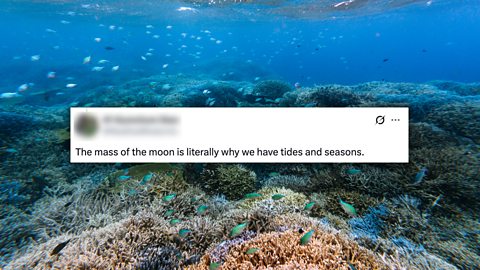
Have you heard about gravitational pull? It’s what creates the tides in our seas. It’s been claimed by some people on socials that the only thing which affects the tides is the Moon - but that’s not true.
Dr Edward Doherty from the NOC explained: “Just like the Earth and the Moon pull on each other with gravity, the Sun and the Earth do too. The Sun is far away, but it’s so big that it still affects our tides. The Sun’s pull is about half as strong as the Moon’s.”
It’s also, Dr Doherty said, a common misconception that the Moon orbits the Earth - they actually orbit each other. One way to visualise it is two figure skaters holding hands while spinning on the ice.
He continued: “Two forces affect the Earth’s tides. The force of gravity between the Earth and the Moon and centrifugal force. When something is spinning, you feel a push outwards, just like when you’re on a roundabout. This pushes the Earth and Moon apart and these two forces create two ocean bulges on opposite ends of the Earth - these are high tides.
“These bulges move as the Earth and the Moon orbit each other. When you combine this with the way the Earth spins on its axis, it creates two high and two low tides each day.”
CLAIM: Melting ice won’t cause sea levels to rise. FALSE
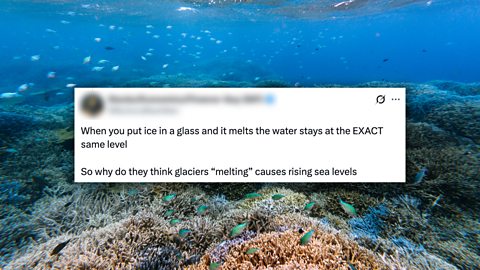
If you watch BBC nature documentaries such as Sir David Attenborough’s Frozen Planet, you will have seen how scientists and naturalists are concerned about the impact of melting ice caps on sea levels around the world.
However, some people on socials believe there’s nothing to be concerned about - using an everyday example to explain why. If you have a glass of water filled with ice cubes, even when the ice melts it doesn’t change the water level. They believe the melting ice in places such as Greenland and Antarctica due to climate change will behave in the same way and that, no matter how much ice melts, the ocean levels won’t be affected.
Dr Matthews explained why this theory is false - and it’s all down to where the ice comes from. “The melting ice causing the bulk of sea level rise is on land, such as glaciers and ice sheets. It’s not floating in the water itself.
“It’s more like melting an ice cube on the rim of your glass. That will raise the level, as you’re adding more water in.”
However, ice that floats on sea water will affect the water level as it melts. It's because sea water contains salt and the water we drink doesn’t. This is where science comes in to play.
Dr Matthews explained: “The ice is fresh water which is less dense than sea water, but it’s a smaller amount than the melting sea ice [from the land].”
That’s different to ice melting in your glass of water. It’s down to displacement, as explained in the complicated-sounding Archimedes Principle. As the ice melts in fresh water, it refills the ‘gaps’ in the water caused by displacement - so the level doesn’t change. In sea water, the amount of melted water is larger than the 'gaps' created by displacement, so it makes the sea level rise.
Nasa, the USA's organisation which deals with space exploration, also observes sea levels. They found that floating ice melting into the sea made levels rise by 1.1mm between 1994 and 2017.
When people make claims about rising sea levels not being true, they may describe it as a conspiracy theory. These are ideas that some secret organisation is working behind the scenes to feed us misinformation - but when you see these claims, remember how important it is to check your facts. When you have all the information at hand, you can then decide whether it’s fake news or not.
This article was published in June 2026

Not sure if the news you’re seeing on social media is true or false? Can you always tell if the things you see online are real or fake?
Learn how to get the other side of the story with our quizzes, videos and explainers about media skills and viral trends including popular food myths.
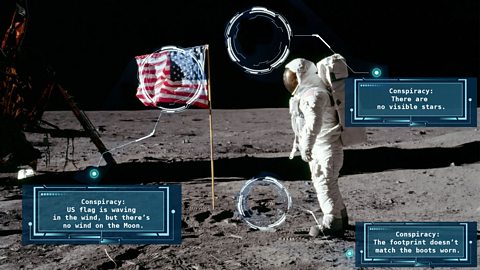
Did we really land on the Moon? Debunking the Moon landing conspiracy theories
We explore some of the most popular conspiracy theories surrounding the Moon landing on 20 July 1969

Other Side of the Story
Back to our homepage for more quizzes and explainers about fake news, viral trends and media skills.