 | 13 November 2014 |

| |
| BBC Homepage | | |
| |||
| Contact Us | | |
Colin EvansYou are in: Berkshire > Local radio > Colin Evans > Colin Evans gardening tips 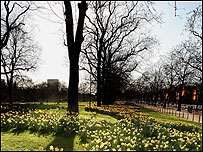 Daffodils Colin Evans gardening tipsColin has a spring in his step and is busy rescuing frog spawn from his hungry goldfish, sowing his sweet peas and clearing his borders of weeds to maximise the show of spring flowers in March. Well into March now and there is much to do to make ready for the new growing season and already the signs are here. Viburnum bodnantense is in full pink flower and the shrub honeysuckle lonicera purpusii are showing masses of yellow white flowers with most heady perfume. 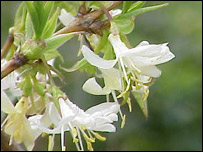 Shrubby Honeysuckle I have already cut the lawns once this week, just enough to make the wonderful shaded lines that look so good from the sitting room through the French windows and cut the edges of the borders to make them stand out from the rest of the garden. The birds just love this as they can spot the worms and other soil borne creatures at a glance and will help to rid the garden of the emerging grubs which are intent on destroying both my flowers and vegetables, so not only does the garden look good the birds love it too. I have also taken the opportunity to run the pump in the fish pond to check all is well and am pleased to report that the pump has survived the winter weather and is working a treat. I spotted frog spawn in the pond with great masses of it mingled with the water plants and whilst it's a real sign of spring around the corner I have some misgivings about this. The goldfish in the pond are getting bigger every year and have a voracious appetite so once the newly hatched tadpoles get to a certain stage they are devoured with great relish. This year I am considering taking the spawn from the pond and storing it in water elsewhere in the garden to preserve as many of these little reptiles who are a great benefit to any garden helping to rid the borders of slugs and beetles. 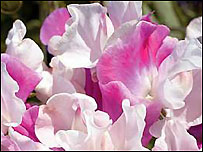 Sweet Pea Now, the bulbs are flourishing and are in full flower and I can see them without stepping on them I have made every effort I can to clear the borders of weeds which have been establishing themselves while the ground has been so wet. You may think that this is a thankless task but once cleared the garden looks so much better. In my view just take time doing the boring jobs like weeding and make sure a nice cup of tea is on the go and you can't go wrong. This week I have moved more small trees and shrubs which were outgrowing their spaces and have planted them in more open positions where we can benefit seeing them even better and where the structure and shape of the garden needs a slight change. Often, more planting can be the answer when reshaping the vista rather than creating more time consuming and high maintenance borders.  If you want dense foliage with unusual colour at this time of the year then you can do no better than to plant a a colorado spruce picea pungens glauca. It's a member of the conifer family and this variety is especially lovely. It has blue needles which grow horizontally in a tiered form. In spring the new growth is a fresh green which will turn blue during the summer months. This conifer makes a great border plant as it's slow growing. Sweet peas can be sown directly into the open ground so prepare the soil by digging down about half the depth of the garden fork and incorporate some compost or leaf mould and fork in just under the soil surface. Firm the ground and sow the seeds just below the surface a few inches apart. All being well they will germinate in a few weeks time. The garden centres also have ready germinated plants which can be planted directly into borders now and since most are in biodegradable containers you don't even need to knock them out of their pots. A few weeks ago I reminded you that your potatoes could be ordered ready for delivery about now. If yours have arrived you should have prepared the soil ready for planting. Once you get your potato tubers they should be removed from the bag and placed upright in some seed trays and stood where there is plenty of light and it's frost free. An unheated greenhouse or shed will do. Wait about three weeks and the shoots should by then be showing and will take us well into March. By this time the tubers can be planted outside either under black polythene or as I prefer to do it with the soil mounded up. If you have little space then planting them in dustbins or large pots will also give you a good crop. Try some of the old type varieties like "Home Guard" and "Arron Pilot" If moss is a problem in the lawn then get yourself some moss killer from the garden centre. Moss is difficult to control in the Thames Valley because the air is generally very moist and has a great environment for moss to flourish. If you want to clear it now is the time, but follow the instruction on the packet to the letter. I just keep the lawn cut on a regular basis and this seems to work to a degree, as I would rather spend money on new shrubs and trees. Happy Gardening last updated: 16/03/2009 at 13:58 SEE ALSOYou are in: Berkshire > Local radio > Colin Evans > Colin Evans gardening tips  Podcast[an error occurred while processing this directive] |
| | About the BBC | Help | Terms of Use | Privacy & Cookies Policy |
