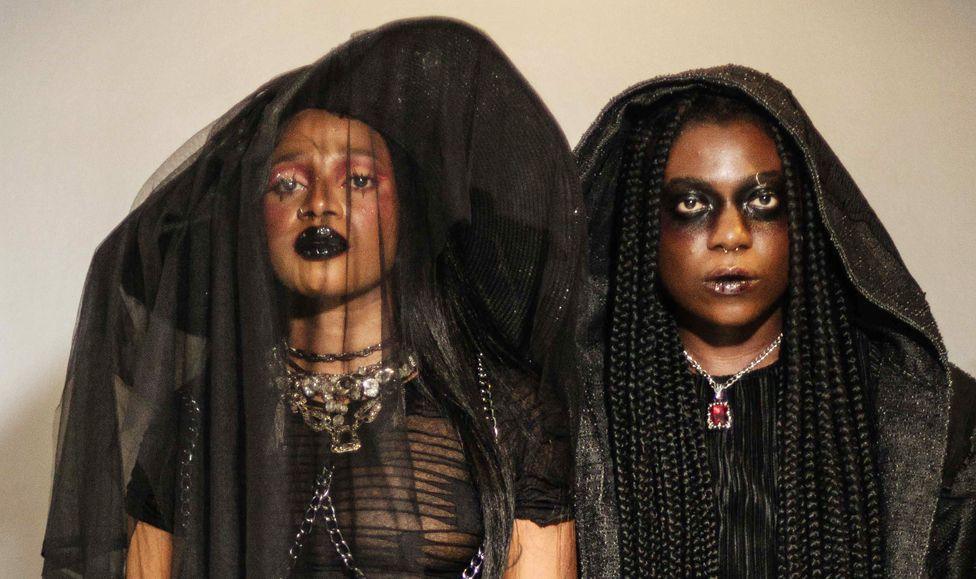
'I found my family in the LGBTQ+ Ballroom scene'

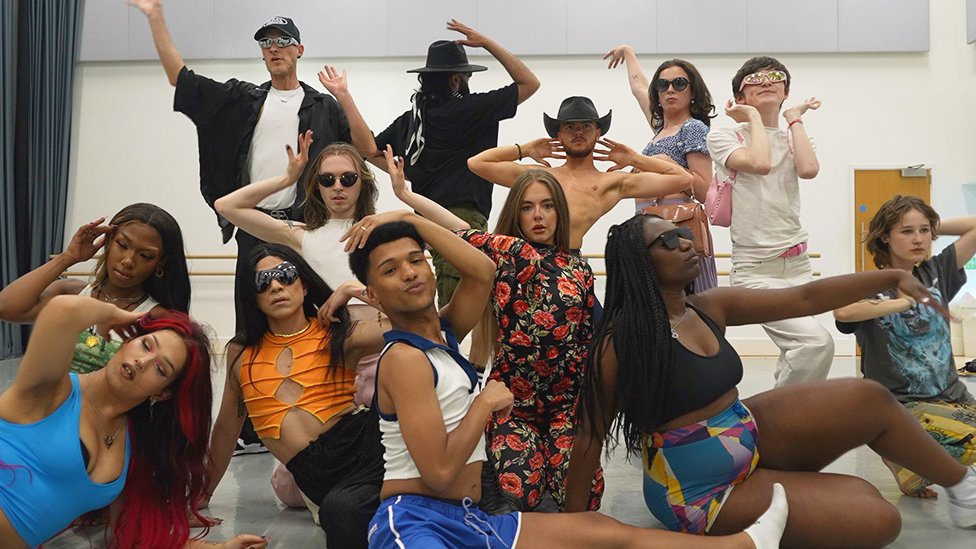
People from Ballroom houses and first-time attendees gathered for the central London event
- Published
"I wouldn't say Ballroom is important to the London scene. Community is more important, and the community just happens to be Ballroom," said Pamela.
Music was pumping through Get Busy, a regular Ballroom event in central London, as Pamela, its co-host, spoke.
Not to be confused with traditional ballroom dancing, the Ballroom scene is an LGBTQ+ subculture where competitors gather for walking balls to battle for trophies.
"Let's not get it twisted, it's still a competition. But in this circle you can find your true family," said co-host and dancer Karteer Mugler, who recently performed for FKA Twigs.
At balls, people compete, either solo or as part of a "house", by walking in front of a panel of judges and showcasing different categories such as face, body, runway and voguing - with the latter one of the most popular categories.

Pamela said the Ballroom scene allowed people to feel that they were "the norm"
Huddled inside a crowded bar in London Bridge, fresh faces turned towards performers as they vogued down the runway, each hoping to leave with a trophy by the end of the night.
It was a scene not unlike the beginnings of Ballroom in Harlem, New York City, where black and Latin LGBTQ+ communities gathered for balls, which became spaces for "vogue" battles that combined dance with high fashion poses from the famous magazine of the same name.
The gatherings were a response to racism experienced within the broader drag pageant culture, and competitors created "houses" to support one another.

The ballroom scene originated in New York City, US
"Ballroom is a community," Karteer said. "It's a way to express your art. There are different types of art in Ballroom, you have fashion, dancing and runway categories."
Each "house" is a family-like unit with a "mother", "father", "brothers" and "sisters". Members compete against different houses across various categories.
Not everyone is in a "house". Those who are not are referred to as free agents, or 007s.

Competitors are often part of "houses", groups that exist to support their members
The Ballroom scene today is a global one. Karteer, who is from France, described Paris as the beating heart of Europe's Ballroom community.
Karteer walks for the House of Miyake-Mugler, which was founded in 1989 in New York City.
He added: "My house really feels like my family in all senses and aspects of life."
It is a sentiment shared by many in the community.

Khoriander, a voguer with the House of Bodega, said the Ballroom scene had brought her around the world
"So many of my friends here I call my family," said Khoriander Bodega, a voguer for the House of Bodega, who has been on the scene for four years.
"Everything I learnt about transitioning, I learnt from people in Ballroom."
Khoriander added: "I used to be in different places every weekend for Ballroom… New York, London, Italy, Athens, Amsterdam, Barcelona, Belgium, France."
Social media is a place for those interested in the scene to connect and share opportunities, with Ballroom content gathering millions of views.
Dancer Karteer, who was recently scouted by English singer, dancer and actress FKA Twigs, said: "If you look at her previous work, she's always worked with people in the Ballroom scene.
"I feel like FKA Twigs always loved voguing.
"I've been in the scene for 14 years now and voguing for 12 years."
Voguing is a stylised dance within Ballroom that evolved through the decades into three dance categories: Old Way, New Way, and Vogue Femme.
But as voguing and Ballroom become more popular, some feel that things are changing.

Voguer Khoriander Bodega says she calls her Ballroom friends her family
Khoriander said: "A lot of things in Ballroom are being watered down because it's so commercial.
"When it was underground there was so much more community, back in the day, in New York, it was really about survival."

Jugu, a Ballroom DJ and model, recently vogued alongside Naomi Campbell for the #Posechallenge
Jugu, a Ballroom DJ, said it was "a little bit upsetting" when phrases that originated in the Ballroom scene were used in the wrong context, such as "clock it".
"I get chills every time someone says it wrong," Jugu said. "Gay black culture has been at the forefront of mainstream language and people will always just get it wrong."
In Ballroom culture, to "clock" someone meant to expose what was real about their appearance or identity.
It is often used in the realness category of Ballroom, where competitors are judged on their ability to "pass", meaning to be perceived as the gender identity they are portraying.
For a few of the Get Busy attendees, it was their first time attending a ball.
Gabriela, who is transgender and from Romania, said: "I'm a very small minority. I'm always trying to find my family and feel like I belong somewhere.
"Having this community supporting and clapping for each other is great.
"I started seeing voguing online, on social media, and felt empowered to believe in myself. This was the first time I've walked and this was my first ball as well - I just felt amazing."

Gabriela said she walked at Get Busy, which was the first Ballroom event she had attended
Beyond the glitz and glamour of Get Busy, Pamela emphasised that Ballroom remained important for the LGBTQ+ community.
"Ballroom is not even a fantasy, it's actually a reality," they said. "But it's a different reality to the one that you have to live every day. It's the one that you choose to live.
"There's not much support out there, so to go to a place where you are the norm, you can really figure out who you are."
Listen to the best of BBC Radio London on Sounds and follow BBC London on Facebook, external, X, external and Instagram, external. Send your story ideas to hello.bbclondon@bbc.co.uk, external
Related topics
- Published17 June 2023
- Published27 June 2024